From a Montessori Guide to Homeschool Parents
One of the most common patterns I see when adults are working closely with children is something that comes from a very good place. The child begins an assignment, reaches a difficult part, looks toward the adult, and the adult immediately steps in to help. A few minutes later, the child has another question. The adult comes back. The child finishes that part and asks what to do next. The adult tells them. Something doesn’t look quite right, so the adult points it out before the child has a chance to notice it. By the end of the lesson, the work is complete, everyone has worked very hard, and yet the adult may have done far more of the thinking than anyone realizes.
This happens in classrooms too. It isn’t uniquely a homeschool problem. When we care about children and want them to succeed, helping feels productive. Sometimes it absolutely is. Children need instruction, modeling, encouragement, correction, and support. Independence does not mean that adults disappear and children somehow teach themselves.
But there is another question I think we should ask ourselves more often: What can this child do without me?
That question is at the heart of independent learning.
Independence isn’t the absence of teaching. It is one of the outcomes of good teaching. We teach children so that, gradually, they can do more without us than they could before.
Independence Doesn’t Mean “Figure It Out Yourself”
Sometimes independence in education is misunderstood. We give children an assignment, walk away, and expect them to complete it because we want them to be independent. When they cannot, we become frustrated because we believe they should be able to do more on their own.
That isn’t necessarily independence. Sometimes it is simply insufficient preparation.
Before a child can independently manage a morning work cycle, someone has to teach them what the work cycle looks like. Before they can organize a long-term project, they need experience breaking large tasks into smaller ones. Before they can take useful notes, someone may need to show them the difference between copying an entire page and identifying information worth recording. Before they can manage deadlines, they need some understanding of time, planning, priorities, and what happens when they underestimate how long something will take.
This is why I don’t think independence should be measured by how little an adult interacts with a child. I am much more interested in whether the child is gradually becoming more capable.
A child who once needed me beside them for an entire math lesson may eventually need me only for the introduction. Later, they may begin independently and come to me when they reach one genuinely difficult problem. Eventually, they may work through that problem themselves, check their work, discover their own error, correct it, and tell me about it afterward.
That progression is far more meaningful than simply saying, “Do it by yourself.”
The adult has not become unnecessary. The adult’s role has changed.
Sometimes We Help Too Quickly
There is a particular kind of silence that adults often find uncomfortable. You ask a child a question and they don’t answer immediately. Five seconds pass. Maybe ten. The child is staring at the paper.
It is incredibly tempting to rescue them.
We rephrase the question. Then we offer a hint. Then perhaps another hint. Eventually, we have constructed so much of the path that the child only has to take the final step.
I have to remind myself of this as an educator too. There are times when a child needs a moment to think.
Struggle isn’t automatically evidence that something has gone wrong.
There is productive struggle and there is unproductive frustration, and learning to recognize the difference is important. A child who has no idea how to begin may need instruction. A child who has been stuck for twenty minutes and is becoming increasingly distressed probably needs intervention. But a child who is thinking, trying one approach, realizing it doesn’t work, erasing it, and trying another may be doing some of the most valuable work of the lesson.
If I interrupt too soon, I may accidentally teach the child something I never intended to teach: When this becomes difficult, wait for an adult.
I would rather help children develop another internal response: When this becomes difficult, what can I try?
That small change matters enormously for independent learning.
Mistakes Need Somewhere to Live
Children also need environments in which mistakes can exist long enough to be noticed.
If an adult corrects every error the moment it appears, the finished page may look wonderful, but the child loses the opportunity to develop self-correction.
Imagine a student working through a page of mathematics and arriving at an answer that doesn’t make sense. Before saying anything, I want to know what the student will do. Will they notice? Will they estimate and realize the answer is unreasonable? Will they check an earlier calculation? Will they try another strategy? Will they ask a specific question?
Those behaviors tell me something about the learner that the correct answer alone cannot.
The same is true in writing. Sometimes I want a student to reread a paragraph and hear that something sounds wrong before I identify the problem. I want them to notice that a sentence doesn’t communicate what they intended. I want them to recognize a word they repeatedly misspell and eventually begin checking it themselves.
A child who can identify and correct an error has gained something different from a child whose work was kept error-free by an adult.
“What Do I Do Next?”
Another habit worth paying attention to is the child who completes every small task and immediately asks an adult what comes next.
Sometimes that is completely appropriate. But if it happens all day, every day, we may need to look at the environment rather than simply telling the child to become more independent.
Does the child know what is expected?
Can they see their work for the day or week?
Do they know what must be completed and what has flexibility?
Do they understand how to prioritize?
Do they know where materials belong?
Can they tell when something is finished?
Do they have a procedure for what to do when they become stuck?
These are organizational skills, and they can be taught.
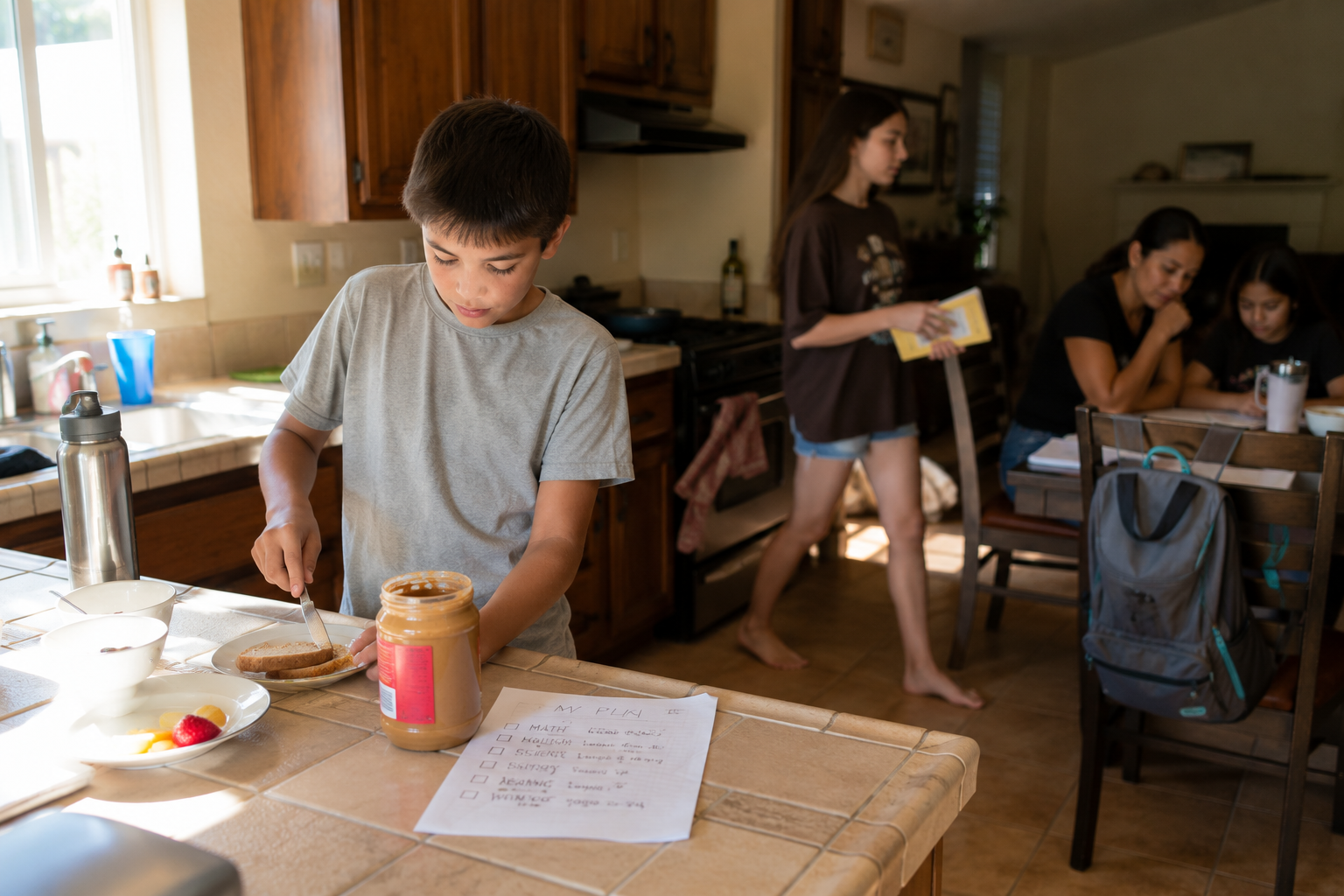
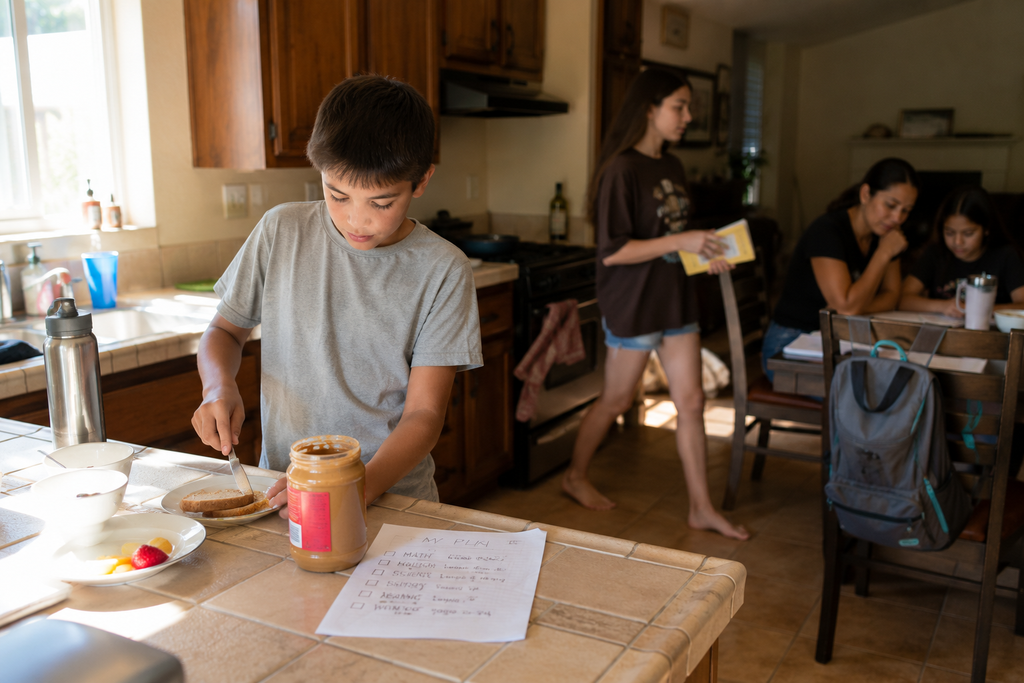
This is one reason I value work plans. A thoughtfully designed work plan isn’t merely a list of assignments. Used well, it begins transferring some ownership of the day to the student. Instead of the adult verbally directing every transition, the child can begin looking at their own responsibilities, determining what has been completed, seeing what remains, and making increasingly appropriate decisions about how to proceed.
For younger children, that process may be heavily supported. For older students, I expect substantially more responsibility. Independence should grow with the learner.
The goal isn’t to create children who never need help. I still ask for help when I need it. So do you. Knowing when and how to seek assistance is itself an independent skill.
What we want to move away from is dependence on another person to initiate every action.
The Prepared Environment Is Quietly Doing Some of the Teaching
Montessori education talks a great deal about the prepared environment, and this is one of the places where its purpose becomes especially clear.
If children constantly need an adult to locate their pencils, find their books, tell them where supplies belong, retrieve materials, explain what work is available, or clean up behind them, then the environment may be creating unnecessary dependence.
A thoughtfully prepared environment answers some questions before a child has to ask them.
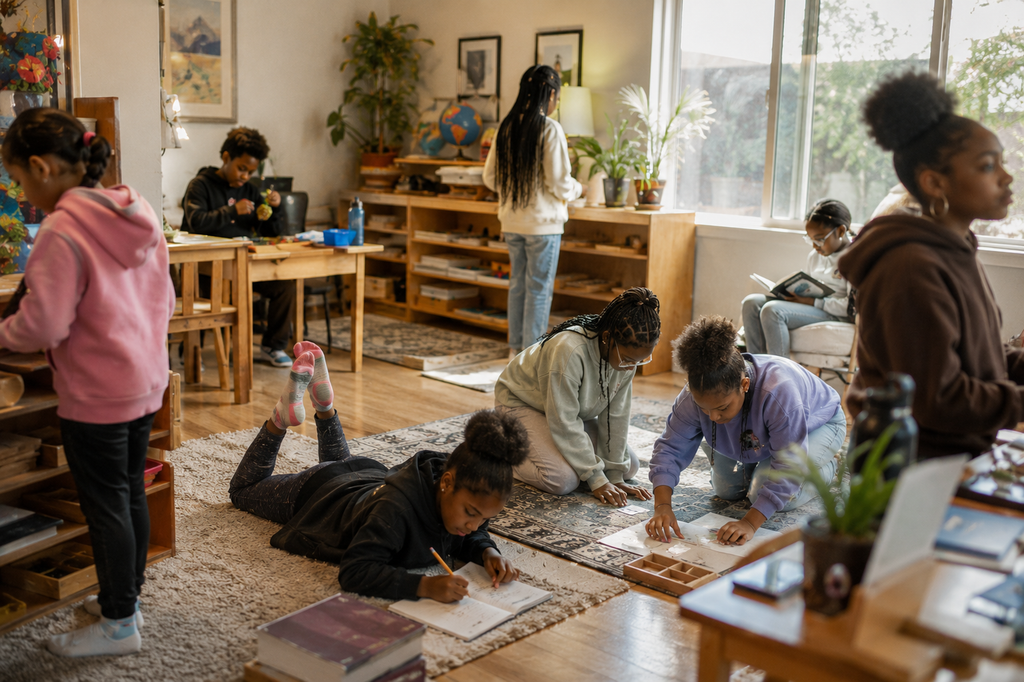
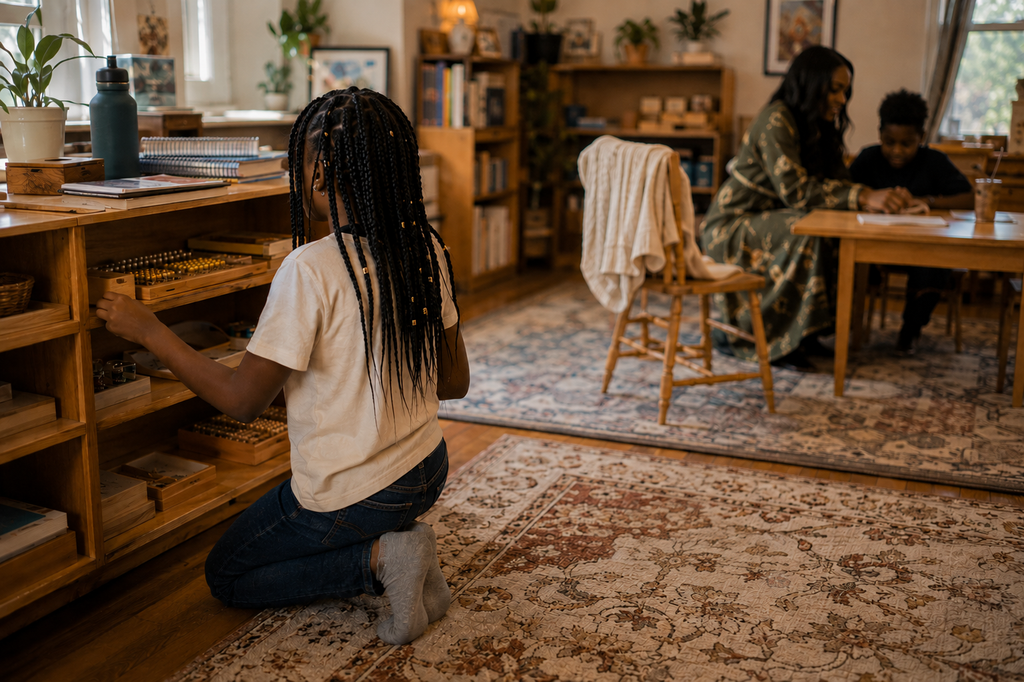
Materials have places. Necessary supplies are accessible. Children can see what is available. There is enough order that they can restore the environment after using it. The space supports work rather than requiring an adult to manage every interaction with it.
A homeschool version doesn’t need to resemble a beautiful Montessori classroom from social media. In fact, I would rather have a practical shelf children can genuinely manage than a perfectly styled one they aren’t allowed to touch.
A prepared environment is not decoration.
It is infrastructure for independence.
Independence Looks Different at Different Ages
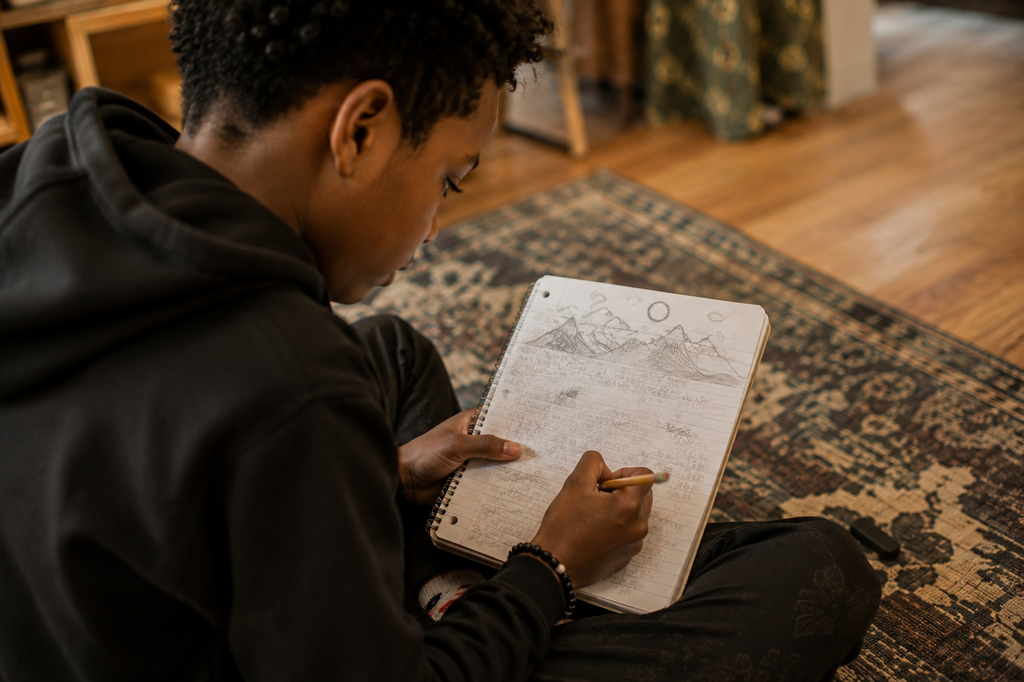
A five-year-old independently preparing a workspace is not the same as a twelve-year-old managing a research project. Expectations have to grow with development, experience, and the individual child.
For a younger learner, independence may mean choosing between appropriate activities, carrying a material carefully, completing a simple work cycle, putting something away, dressing themselves, preparing a snack, or remembering where a familiar item belongs. Those tasks may look small to adults, but they are helping establish an important internal message: I am capable of doing things for myself.
As children move through elementary school, the responsibilities become more complex. They can begin managing larger portions of their work, maintaining notebooks, following multi-step directions, preparing materials, monitoring assignments, contributing meaningfully to household responsibilities, and solving ordinary problems before immediately seeking adult intervention.
By middle school, I want students participating much more actively in the management of their own education. They should increasingly understand what they are working on, why they are working on it, what is due, where their materials are, what they have completed, where they are struggling, and when they genuinely need help.
None of this appears overnight because a child reaches a certain birthday.
It develops through hundreds of small opportunities to practice responsibility.
That is why I don’t want to wait until adolescence and suddenly announce that a child needs to become independent. We can begin building the underlying habits much earlier.
Independence Is Not the Same as Compliance
This distinction matters to me.
A child who immediately does everything an adult says is not necessarily an independent learner. They may simply be very good at following directions.
There is value in being able to follow directions, cooperate with others, respect boundaries, and fulfill responsibilities. Those things are part of living in a community.
But independent learning asks for something more.
Eventually, I want a child to initiate.
I want them to recognize a problem before I point it out. I want them to develop questions I did not give them. I want them to know where to look for information. I want them to make reasonable decisions when every step has not been predetermined. I want them to recognize when their work is not their best and decide to improve it.
That requires judgment.
Judgment develops when children are given appropriate opportunities to use it.
The Goal Is Not to Become Unnecessary
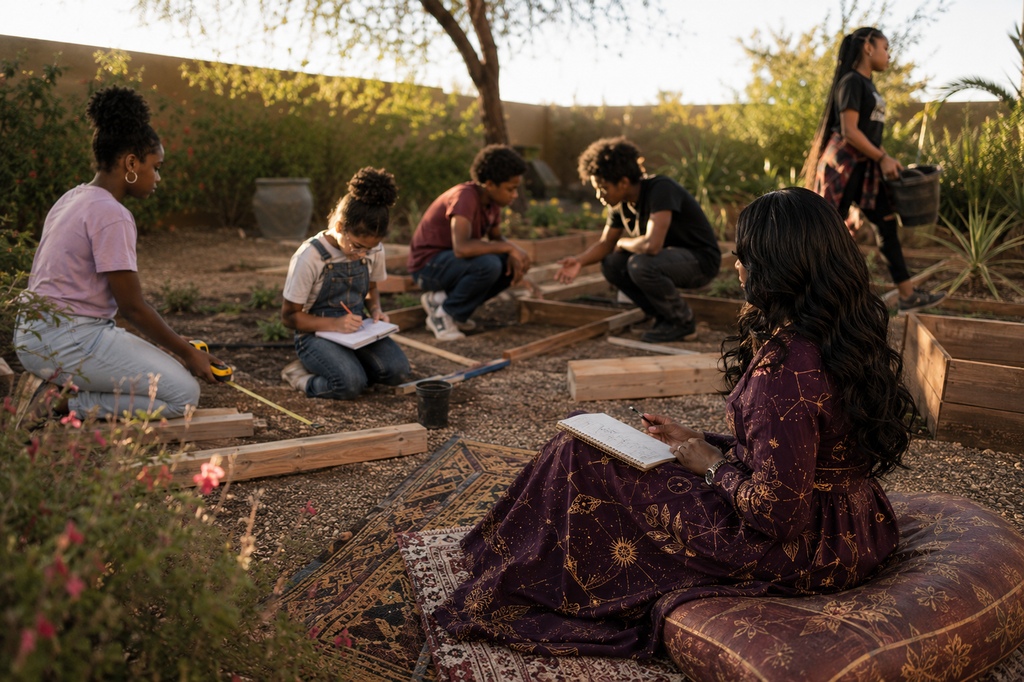
There is something beautiful about watching a child do something independently that once required your help. It may be something academically significant, like writing a thoughtful essay without needing someone to organize every paragraph. It may also be something as ordinary as noticing that their pencil needs sharpening, getting up, taking care of it, and returning to work without saying a word.
Those moments are easy to overlook because eventually they become normal.
But that is development happening in front of us.
The goal of teaching isn’t to create a child who never needs another person. Human beings aren’t meant to live that way. We collaborate, ask questions, seek expertise, teach one another, and depend on our communities throughout our lives.
The goal is to make sure that help remains help, rather than becoming the mechanism through which everything gets done.
I want students to know that asking for help is perfectly appropriate. I also want them to have enough confidence to try something before deciding they cannot do it. I want them to know the difference between being confused and being challenged. I want them to become increasingly capable of planning, beginning, persisting, correcting, completing, and reflecting on their own work.
For homeschool parents, that sometimes means doing something that feels surprisingly difficult.
Waiting.
Watching.
Allowing the child to struggle for another minute.
Letting an imperfect attempt exist.
Giving a smaller hint instead of an answer.
Allowing the child to experience the natural consequence of forgetting something manageable.
And noticing all of the little things your child can now do that once required you.
That is how independent learning grows. Not because we suddenly withdraw support, and not because children are expected to figure everything out alone, but because support changes as competence grows.
We show them.
We practice with them.
We remain available.
And, little by little, we make room for them to do it themselves.
At Quantum Montessori®, we believe independence is developed intentionally. Through prepared environments, individualized work, meaningful responsibility, observation, and appropriate support, students are given opportunities to become increasingly capable of managing their learning while knowing that guidance is available when they genuinely need it.
Leave a Reply