

Structure matters, but recreating a conventional classroom schedule at home can work against some of the very advantages homeschooling gives children.
From a Montessori Guide to Homeschool Parents
One of the first things many families do when they begin homeschooling is make a schedule.
I understand why.
Leaving a conventional school environment can create an uncomfortable amount of freedom. There is no bell telling everyone when mathematics begins. There is no lunch period printed on a master schedule. Nobody has assigned science to fourth period or decided that reading gets exactly forty-five minutes before everyone has to stop.
So we create those boundaries ourselves.
Math from 8:00 to 8:45. Reading from 8:45 to 9:30. Writing next. Science after that. Lunch at the appropriate time. Something educational in every available space because otherwise we begin wondering whether we are really doing enough.
Pretty soon, we have recreated school at the kitchen table.
I do believe children need structure. I use work plans. I teach live lessons at scheduled times. There are assignments that need to be completed, skills that need deliberate practice, books that need to be read, and responsibilities that do not disappear simply because a family homeschools.
But a useful homeschool schedule does not have to divide a child’s entire day into small academic pieces.
Sometimes the better question is not, What subject should come next?
It is, Does this child actually need to stop what they are doing?
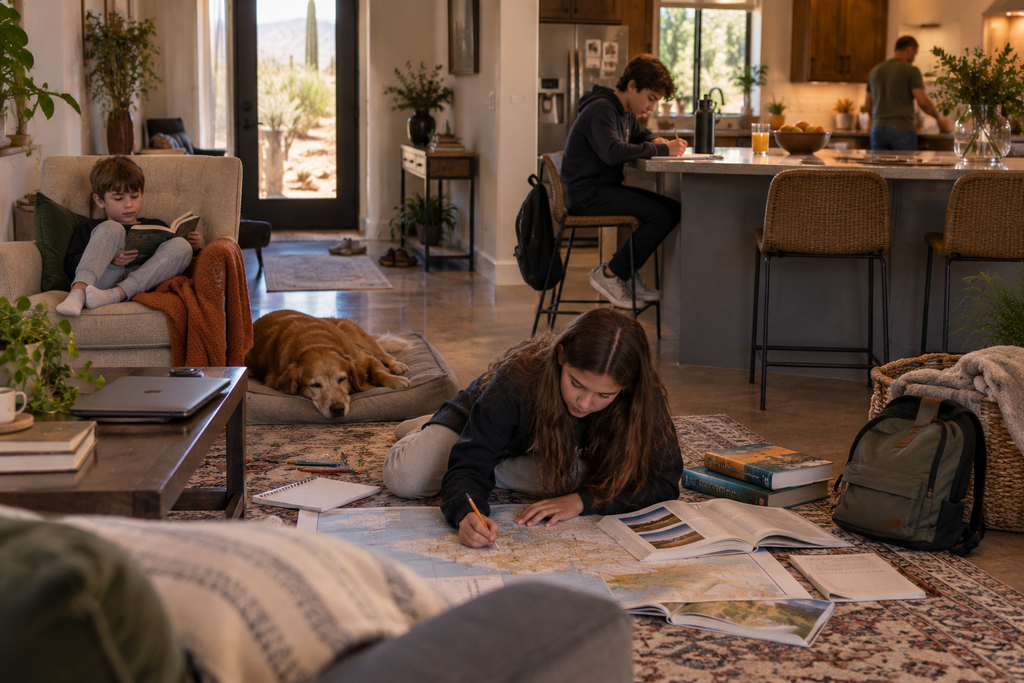
A Schedule and a Rhythm Are Not Quite the Same Thing
There is a difference between knowing what needs to happen during the day and deciding that everything must happen at an exact minute.
A schedule tells us that mathematics begins at 9:00 and ends at 9:45.
A rhythm can tell us that after breakfast and getting ready for the day, we settle into our first substantial work period. Mathematics may be part of that period. So may writing, reading, research, or work that began the day before.
There are families and children who genuinely benefit from precise times. There are live classes that obviously require them. Appointments happen at specific times. Some students regulate themselves much better when they know exactly what is coming and when.
I am not interested in eliminating schedules simply because homeschooling allows us to.
I am interested in being thoughtful about what the schedule is doing for the child.
If a time boundary helps the student begin, transition, remember a responsibility, or manage the day, it is useful.
If the only reason we are stopping a deeply concentrated child at 9:45 is because the schedule says mathematics has ended, I want to know whether that boundary is still serving us.
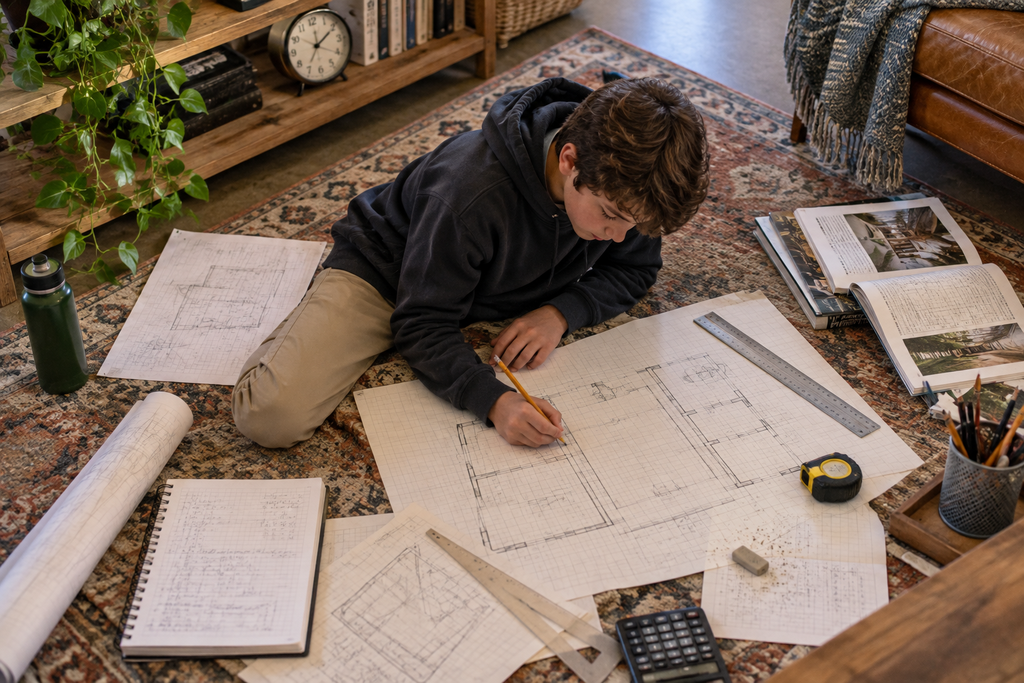
The Work Cycle Gives Children Time to Get Somewhere
One of the things I value about Montessori education is the uninterrupted work cycle.
Children need time to begin working, but they also need enough time to get beyond beginning.
That distinction matters.
If I ask a child to start something and then interrupt them shortly after they finally settle into concentration, we may spend a surprising amount of the day practicing transitions instead of practicing sustained thought.
Some work needs time to become interesting.
Writing is a good example. A student may spend the first several minutes staring at the page, looking through notes, writing a sentence, crossing it out, and beginning again. If we stop there, it can look as though very little happened.
Give the same student enough uninterrupted time and the idea may finally begin moving.
Research can work the same way. So can mathematics, reading, construction, art, science, and project work.
Concentration often has an entry period.
I do not want to repeatedly pull children out just as they get there.

Live Lessons Can Anchor the Day Without Taking Over the Day
Our students do have scheduled live instruction.
That structure matters.
A live lesson gives us an opportunity to introduce something, model a process, discuss a text, work through mathematics together, ask questions, hear another student’s thinking, and establish what comes next.
But I do not want the entire educational experience to remain inside that meeting.
The lesson should lead somewhere.
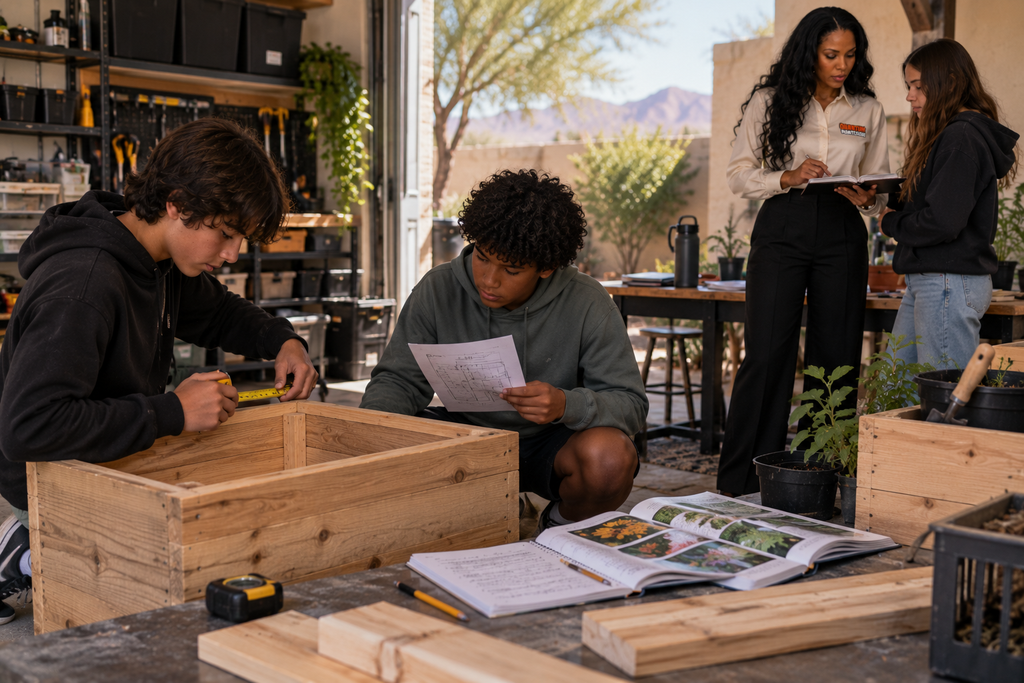
A student may leave a mathematics lesson and continue working on paper. A discussion about a novel should eventually send the child back into the actual book. A science lesson may lead to an experiment that happens in the kitchen, backyard, or outside in the Arizona desert. Something introduced in social studies may become research that lasts well beyond the live meeting.
The scheduled portion anchors the learning.
It does not have to contain all of it.

Not Every Subject Needs Its Own Little Box
Children do need explicit instruction in different academic areas. I am not suggesting that a project automatically teaches everything a child needs to know.
It does not.
Sometimes we sit down and learn grammar because the child needs grammar instruction. Sometimes mathematics requires deliberate practice. Handwriting may need focused attention. A student may need systematic vocabulary work or direct instruction in a skill they would not simply discover through an interesting project.
What I resist is the idea that those subjects always remain separate in the child’s actual thinking.
A student researching architecture may suddenly need mathematics.
A child cooking encounters fractions without asking whether it is currently math time.
A science investigation requires writing because the student needs to record what happened.
History sends a student into geography.
Reading creates a question that becomes research.
Real intellectual work has very little respect for the labels we place on the school day.
That can be one of homeschooling’s strengths if we allow it.
A Break Is Not Wasted Time
Children need breaks.
Older students need them too.
I am not concerned when a student finishes a substantial period of concentrated work and needs to eat something, walk outside, stretch, sit somewhere quiet, talk to a sibling, or simply stop thinking about school for a while.
That is different from spending the entire work period repeatedly escaping the work.
Observation helps us distinguish the two.
Sometimes a child asking for the fifth break in thirty minutes is telling us something about the work. Maybe it is too difficult. Maybe the student does not know how to begin. Maybe they are distracted. Maybe we need to adjust the environment.
But a child who has been genuinely concentrated for a long period and then gets up to make lunch is not failing to stay on schedule.
They may be learning to recognize what their body and attention need in order to return to the work well.

Family Life Does Not Have to Be Hidden From Homeschooling
One of the strangest things we can do when homeschooling is behave as though the home itself is an inconvenience we need to remove from education.
Laundry exists.
Lunch has to happen.
The dog needs to go outside.
Someone has a dentist appointment.
A younger sibling may need something.
A parent may be working.
There are library books to return, groceries to buy, and days when the family needs to leave the house before the beautifully planned work cycle is finished.
This does not mean academic work should constantly be abandoned whenever something else appears.
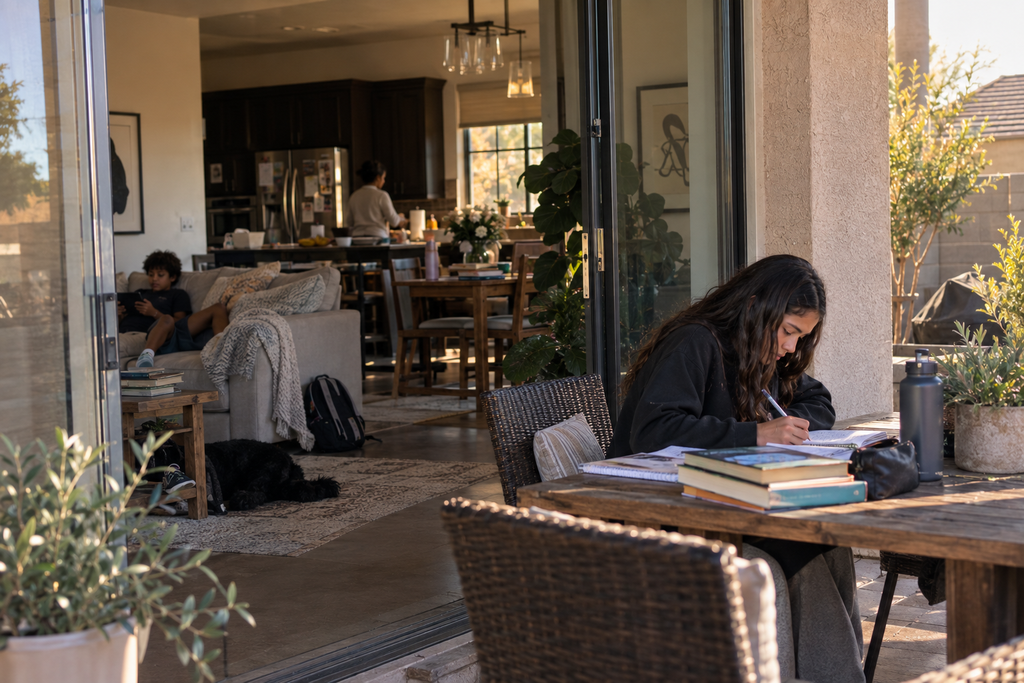
It means home education happens inside a home.
Children can gradually learn how to manage both.
An older student may know that a live class begins at ten, so the dog needs to be taken outside before then. A child may begin preparing lunch after finishing a substantial piece of work. A library trip can become part of the weekly rhythm rather than an interruption to school.
That is not a lesser educational environment.
It is a different one.

Some Children Need More Structure Before They Can Handle More Freedom
Flexibility sounds wonderful until a child has absolutely no idea what to do with it.
A student who has spent years having every part of the day directed by adults may not immediately flourish when someone hands them a work plan and says, “Manage your time.”
That is an enormous executive-function demand.
Independence has to be developed.
For some students, I may initially provide much more structure. We decide what needs to happen first. We establish a predictable work period. I check in more frequently. A parent may help the child prepare the environment before work begins. The student’s plan may be shorter and more explicit.
Then I watch.
As the student demonstrates that they can manage one part independently, the adult can release a little more.
Over time, the structure moves from something entirely imposed from outside the child toward something the child increasingly understands how to create for themselves.
That is very different from removing all expectations in the name of flexibility.
Freedom within limits still has limits.
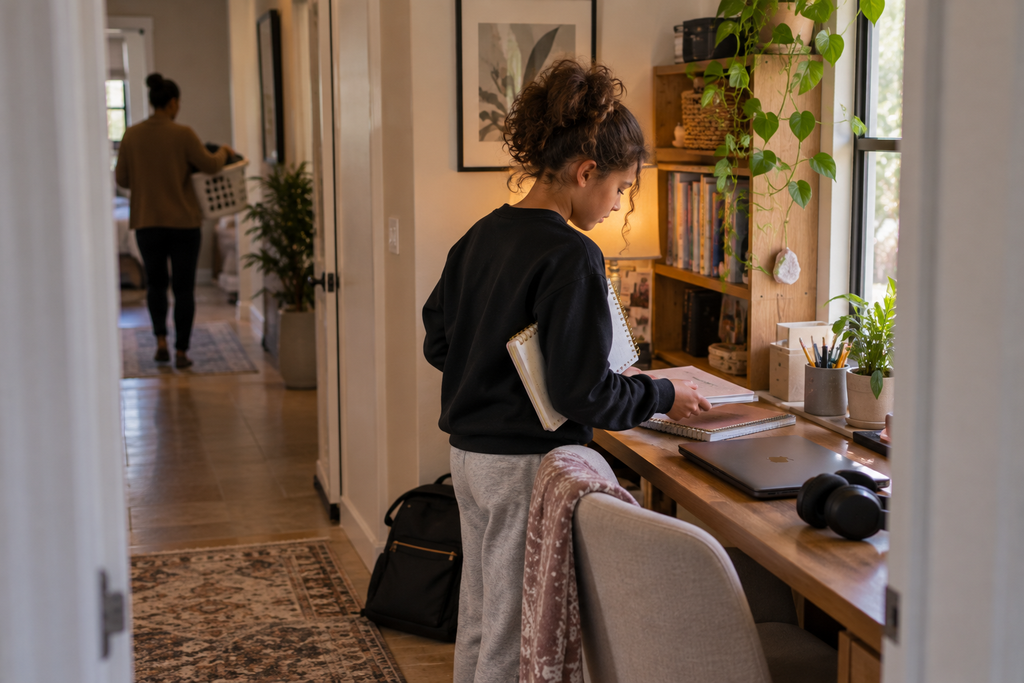
A Good Homeschool Schedule Should Become Less About the Clock
I want students to develop an internal understanding of work.
They begin to recognize that some things have fixed times and others do not. They learn that a difficult task may be easier to approach earlier in the day. They discover how long certain kinds of work actually take them. They begin noticing when they are concentrating well and when they are merely sitting beside the work.
Eventually, an older student can look at what needs to be accomplished and make decisions.
There is a live class at a particular time. There is a substantial assignment that will require uninterrupted attention. There is independent reading that can happen later. There is a project the student wants to continue. There are responsibilities outside academics that also belong to the day.
The goal is not for the child to become obsessed with productivity.
The goal is for the child to understand how to manage meaningful work.
That ability will matter long after nobody is checking whether they began mathematics at 9:00.

The Goal Is Not to Produce a Perfect Homeschool Day
Some days will flow beautifully.
A child will begin working, settle into concentration, move naturally between responsibilities, finish what needs to be finished, read for pleasure, help with something at home, and somehow still have energy left at the end of the day.
Other days will not look like that.
The mathematics takes twice as long as expected. Someone cannot find the book. A live lesson reveals that we need to go back and review something. The science experiment fails. The younger sibling interrupts. The appointment runs late. The student is tired. The work plan that looked completely reasonable in the morning turns out not to be reasonable at all.
That does not automatically mean the schedule failed.
Sometimes the most useful thing a homeschool day gives us is information.
We learn that the child needs more time for writing than we thought. We notice that mathematics goes much better before lunch. We discover that scheduling three demanding tasks back-to-back produces very little meaningful work by the third one. We realize that the student is ready to manage more independently, or that we released responsibility too quickly and need to provide more support again.
Then we adjust.
A homeschool schedule should be something we use to support learning, not something the family has to serve.
Structure Should Help the Child Work, Not Become the Work
When families ask me what their homeschool day should look like, I understand the desire for a precise answer.
It would be convenient if there were one perfect schedule I could hand every family.
There isn’t.
The kindergartner, the fifth grader, and the middle school student should not necessarily have identical work cycles. A child who is still learning how to manage independent work may need a different level of structure from a student who has demonstrated that they can plan and follow through. A family with scheduled live classes has different fixed points in the day from a family working primarily through independent homeschooling.
What I want is enough structure that the child knows what is expected without so much unnecessary scheduling that the structure begins interrupting the learning it was supposed to support.
There should be room for concentration to deepen.
There should be room for a question to become research.
There should be room for a project to take longer than expected because something genuinely interesting happened.
There should also be enough structure to make sure the difficult work does not quietly disappear because the child would rather spend all day on the thing they already love.
That balance changes as children grow.
In the beginning, much of the rhythm may belong to the adults. We prepare the environment, establish the work period, help the child begin, protect their concentration, and make sure necessary work is not continually avoided.
Then, little by little, some of that responsibility changes hands.
The student begins knowing what needs to happen.
They begin making decisions about when and how to approach it.
They begin understanding that flexibility is not the absence of responsibility. It is the ability to manage responsibility with increasing independence.
That is where I want the homeschool schedule to lead.
Not toward a child who needs a bell to tell them when learning begins and ends.
Toward a young person who increasingly understands how to begin meaningful work, stay with it, stop when stopping makes sense, return when necessary, and take responsibility for what still needs to be done.
Home gives us room to practice that.
We do not need to turn it into school first.
Leave a Reply