Montessori Education
What Selling Girl Scout Cookies Can Teach a Child That a Worksheet Cannot
Some of the most important lessons happen outside of any lesson plan.
From a Montessori Guide to Homeschool Parents
There are lessons we deliberately teach children, and then there are lessons that quietly show up because a child has something real to do. A worksheet can ask a student to calculate money, write a persuasive paragraph, set a goal, interpret numbers, or practice speaking clearly. Real life has a way of asking for all of those skills at once, usually without announcing which subject the child is practicing.
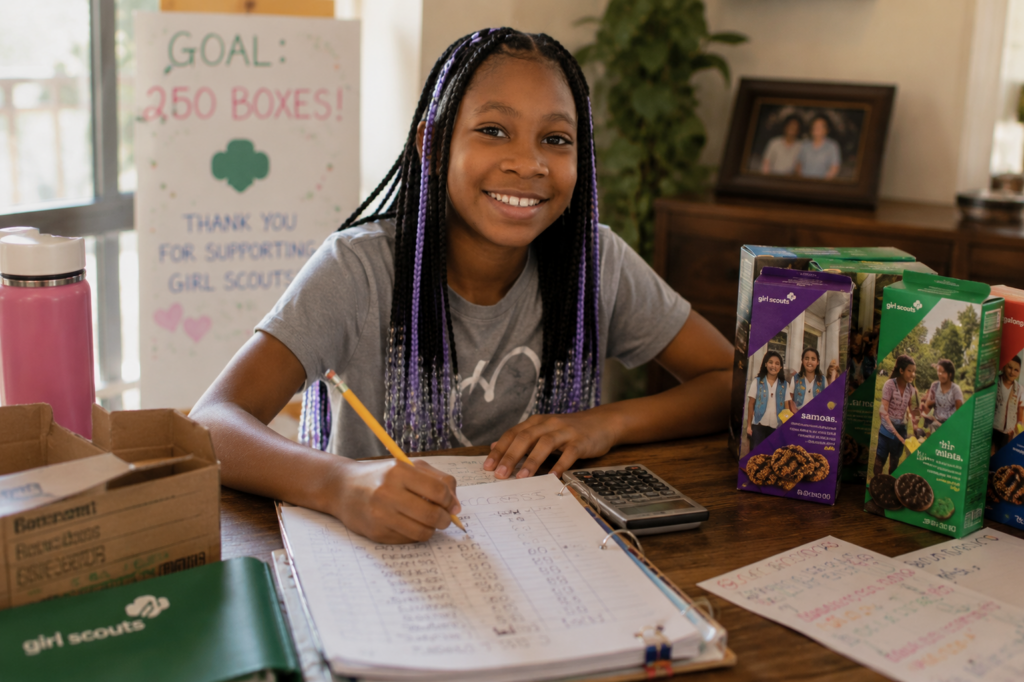
A few years ago, one of those opportunities arrived at Quantum Montessori through my daughter, Chloe. She was eight years old and beginning her Girl Scout journey. Like generations of Girl Scouts before her, she was also selling cookies. At first glance, selling cookies might seem like a simple childhood fundraiser. You have cookies, people buy them, and the troop raises money. But when I looked at the experience through the eyes of a Montessori Guide and a parent, I saw something much larger happening.
Chloe was practicing practical life skills in one of the best ways children can practice them: she had a real goal, real people were involved, her decisions mattered, and there was no answer key waiting at the bottom of the page. The original purpose was simply to support her Girl Scout troop and participate in something she was excited about. The learning happened because the experience required it.

Practical Life Skills Become More Interesting When Something Is Actually at Stake
One of the things I appreciate about Montessori education is that Practical Life is not supposed to be separated from life itself. When children are little, we may intentionally prepare activities that allow them to pour, wash, button, sweep, prepare food, care for their environment, and develop coordination. As children grow, those same developmental needs do not disappear. The work simply becomes more sophisticated. Older children need opportunities to plan, organize, communicate, manage resources, solve unexpected problems, contribute to a community, and gradually become responsible for work that actually matters.
Selling cookies gave Chloe exactly that kind of experience. If someone ordered cookies, she needed to keep track of the order. If she had a sales goal, she needed to understand where she was in relation to that goal. If she wanted someone to buy something, she had to communicate with them. If someone said no, the interaction did not stop being valuable. If something was forgotten, miscounted, or misunderstood, there was a reason to correct it beyond getting a better grade.
That difference matters. A child can complete twenty perfectly designed problems about money without feeling any particular connection to the numbers. Give that same child actual money, actual inventory, an actual goal, and people waiting for the correct order, and suddenly those numbers have consequences. Mathematics has become useful.

Mathematics Looks Different When the Answer Belongs to You
There is something wonderfully clarifying about mathematics when a child wants the answer. How many boxes have I sold? How many more do I need? How much will these orders total? Do these numbers match? What happens if three people each order the same number of boxes? Which variety is selling fastest? How can I organize this so I do not lose track?
We can teach addition, subtraction, multiplication, data, money, estimation, and even introductory ideas about profit and expenses through carefully prepared lessons. We should. Children need explicit instruction. But application is where we begin to see whether knowledge is becoming usable.
That does not mean turning every childhood experience into an academic assignment. I would not hand a child a five-page packet after selling cookies and announce that we have successfully transformed her fun into school. Sometimes adults can become so determined to extract educational value from an experience that we remove the very thing that made the experience valuable.
Instead, I observe. I notice what the experience naturally requires. I answer questions. I introduce a tool when it becomes useful. I may ask a question that helps the child think a little further. Then I allow the work itself to provide much of the motivation.
That is very different from artificially attaching academics to everything a child enjoys.

The Customer Is Not a Worksheet
The communication involved may be even more valuable than the mathematics. Children eventually have to learn how to speak to people who are not their parents, teachers, siblings, or close friends. They have to introduce themselves, explain something clearly, listen to a question, respond appropriately, remember information, say thank you, and occasionally recover when they do not know what to say.
That can be uncomfortable.
And that is part of the learning.
A child can practice a script before approaching a customer, but the customer does not have a copy of the script. They may ask a completely different question. They may change their mind. They may want something the child does not have. They may say no. They may be in a hurry. They may want to have an entire conversation.
Suddenly communication is not about producing the sentence an adult expected. It is about understanding another human being and figuring out how to respond.
There is also an important emotional lesson hiding inside those interactions. A “no” is not necessarily a rejection of the child. Someone can decline to buy something, and the child can still smile, thank them, and continue with her day. That distinction between someone said no to my offer and someone rejected me is a surprisingly useful lesson for a young person to begin learning.

Responsibility Includes the Parts That Are Not Particularly Fun
Children often enjoy the beginning of a project. The idea is exciting. The supplies are new. The goal feels interesting. Then comes the middle.
That is usually where some of the best practical life skills begin developing.
There are things to remember. Something needs to be organized. A task takes longer than expected. The child may need to follow through when she would rather do something else. There may be a mistake to fix. Someone may be waiting. The excitement that launched the project is no longer enough to carry it.
This is where responsibility begins to become more than simply doing what an adult says.
When a child has taken ownership of something, we can gradually allow her to experience the weight of that ownership. We do not have to rescue her from every forgotten detail. We also do not have to abandon her and call that independence. We can provide enough support for the child to remain successful while resisting the temptation to quietly take over because we could accomplish the task faster.
That balance is important in Montessori education. Independence does not mean adults disappear. It means our help changes as the child’s competence grows.

Entrepreneurship Is Bigger Than Selling Something
I also think experiences like this give children an early introduction to entrepreneurship without requiring us to turn every child into a miniature CEO.
Entrepreneurship at this age can simply mean recognizing that something you do has value to another person, learning how an exchange works, understanding that resources are limited, setting a goal, communicating an offer, managing what you have, and following through on what you promised.
Some children will love that. Others will discover that selling is absolutely not their thing. Both discoveries are useful.
One child may become fascinated by the numbers. Another may love designing the display. Someone else may be surprisingly comfortable talking to customers. Another child may prefer organizing inventory behind the scenes. A student might begin asking where products come from, how prices are determined, why some things sell more quickly than others, or what happens to the money afterward.
Those questions can lead into mathematics, economics, writing, design, technology, history, ethics, or social studies. The child’s curiosity begins creating connections between subjects that adults often separate.
That is the kind of interdisciplinary learning I want children to experience.

Community Matters Too
The original Girl Scout experience was not only about selling cookies. Girl Scouting also introduced Chloe to service, leadership, participation, and being part of something larger than herself. That community component matters.
Children need opportunities to contribute, not only opportunities to achieve. There is a meaningful difference between asking, “What did I get from this?” and beginning to understand, “What did my work make possible for other people?”
A child can help prepare something for a group. She can contribute to a service project. She can help younger children. She can participate in an organization. She can care for a shared environment. She can create something that other people will actually use. She can learn that membership in a community comes with both benefits and responsibilities.
This is another reason I hesitate when people reduce education to academic output. Reading, mathematics, science, history, and writing matter enormously. But eventually we are asking children to use what they know while living among other people.
Education has to prepare them for that too.

Sometimes the Best Lesson Is the One We Did Not Design
When I think back on Chloe’s experience, I do not think the most important part was the number of cookies sold. I think about everything that had to happen around the sale: deciding to participate, setting goals, talking to people, keeping track of information, handling money and numbers, following through, contributing to her troop, and discovering that she could do things that required a little courage and responsibility.
Those are real practical life skills.
And that is the larger lesson I want homeschool parents to take from experiences like this. We do not have to recreate school around every corner of our homes in order for serious learning to happen. Sometimes the most useful thing we can do is notice when real life has already created an opportunity and resist the urge to overmanage it.
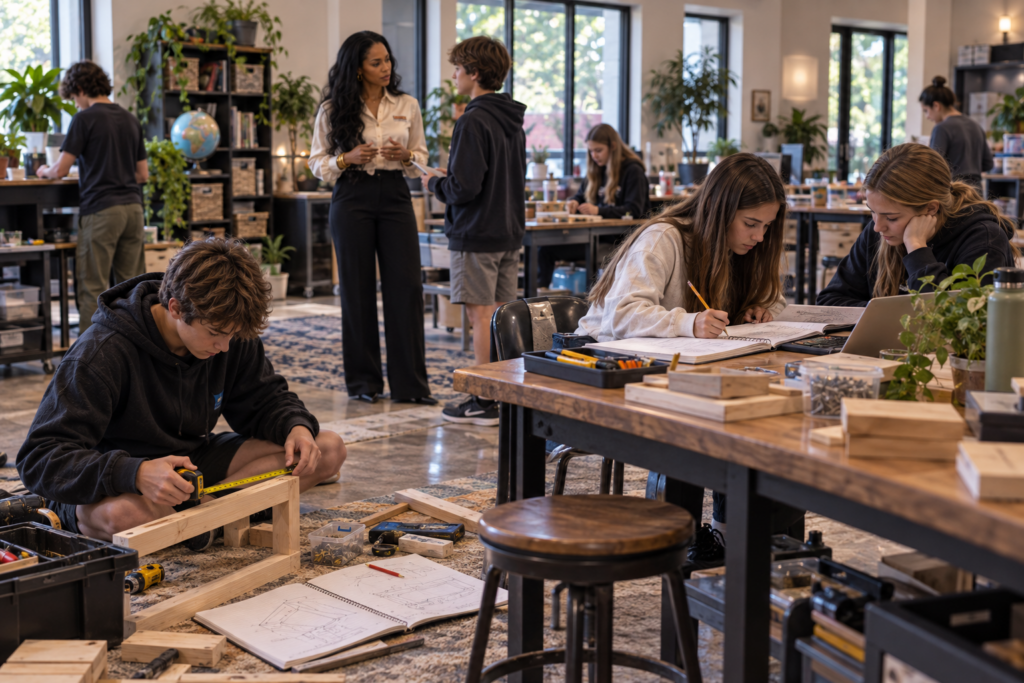
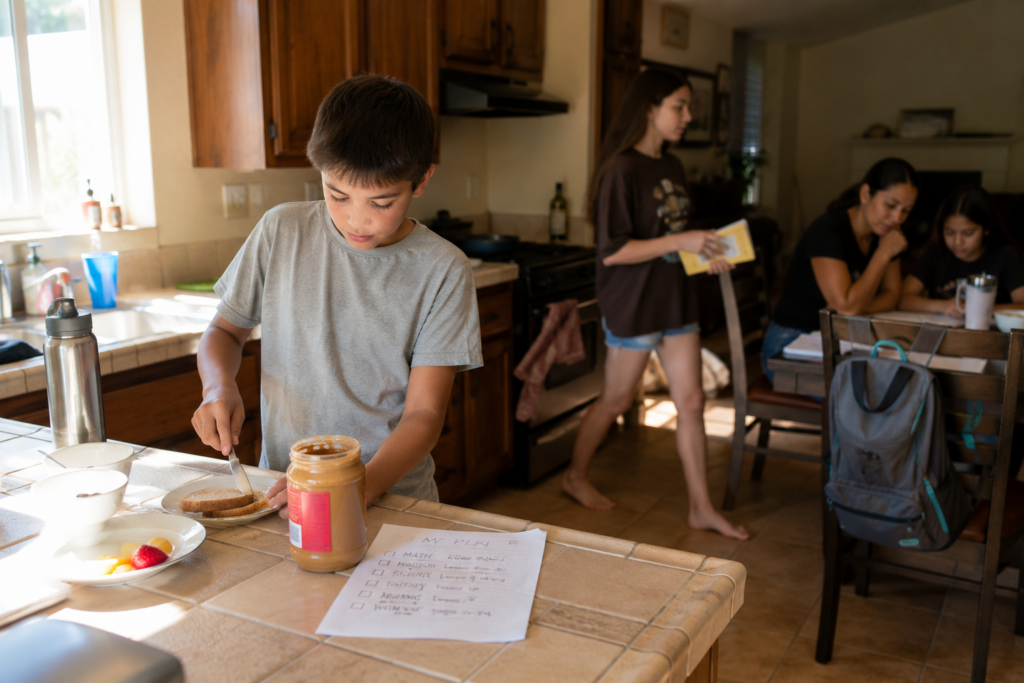
Let the child make the phone call when she is ready. Let her calculate the total. Let him measure the wood. Let them plan the meal. Let the student realize the count is wrong and try to figure out why. Let the child speak to the customer. Let the project become inconvenient enough that organization actually matters.
We can teach before the experience. We can support during it. We can talk about what happened afterward. But somewhere in the middle, children also need room to discover that the knowledge and skills we keep teaching them are useful for something beyond completing schoolwork.
A worksheet can ask a child what she would do.
Real life occasionally gives her the chance to find out.


Written by the Guides of Quantum Montessori, who teach students from preschool through high school in our homeschool, hybrid, distance learning and Learning Pod programs. Explore our programs.