Montessori Education
What Observation Actually Looks Like for a Homeschool Parent
Montessori Guides spend a surprising amount of time simply watching. Here is how homeschool parents can borrow that habit, and why it often tells you more than a test.
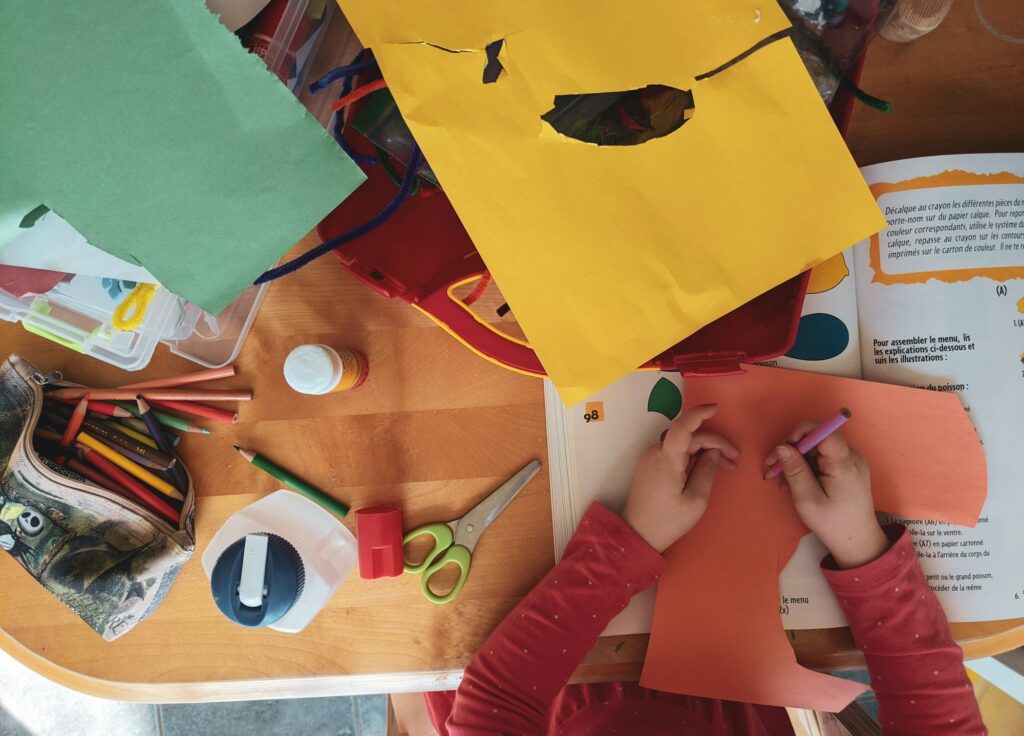
If you walk into a Montessori classroom during a work cycle, you may notice the Guide is not always teaching. Sometimes she is sitting quietly with a notebook, watching. To a visitor, this can look like doing nothing.
It is one of the most important things she does all day.
Observation is the foundation of Montessori teaching. Before we decide what a child needs next, we try to understand what they are actually doing now. Homeschool parents can use the same practice, and it does not require any special training. It requires slowing down and paying a particular kind of attention.
Watching without stepping in
Most parents observe their children constantly, but usually with a purpose. We watch to make sure they are safe, on task, or finished. We watch so we can correct, redirect, or help.
Montessori observation is different. The goal is to see what the child does when you are not shaping it. You are gathering information, not managing behavior.
This is harder than it sounds. When you see your child struggle to fit a puzzle piece, or start a math problem the long way, the instinct is to step in. Try waiting. Notice what they try next. Notice how long they persist, and what they do when they get stuck.
You can always help later. The information you get from waiting is not available any other way.
What to look for
When you sit down to observe, it helps to have a few questions in mind. You do not need to answer all of them every time.
- What does my child choose when given a choice?
- How long do they stay with one activity?
- What do they do when something is difficult?
- When do they seem most focused? Morning? After lunch? After being outside?
- What do they avoid?
- What makes them light up?
- How do they handle materials? Carefully? Quickly? With frustration?
- What do they say to themselves while they work?
Over time, patterns appear. You might notice your child concentrates beautifully on writing in the morning but falls apart with the same task at three in the afternoon. You might notice they rush through math that is too easy and get quiet when it becomes slightly challenging. You might notice they always choose to work near you, or always choose to work alone.
Each of these patterns is useful. Together, they give you a picture of your learner that no grade level can.
Write it down
Observation becomes far more useful when you keep a record. Memory is unreliable, especially across weeks.
You do not need a formal system. A notebook works. Write the date, the time, what your child was doing, and what you noticed. Keep it short and factual. “Worked on the multiplication chart for 22 minutes. Skipped the 7s. Hummed while working.” That is enough.
Try to separate what you saw from what you think it means. “She sighed and put her head down” is an observation. “She was frustrated” is an interpretation. Both are useful, but keeping them separate helps you notice when your interpretation might be wrong.
After a few weeks, read back through your notes. You will often see things that were invisible day to day.
Observation is not surveillance
There is an important difference between observing a child and hovering over them. Children can feel the difference.
Observe from a comfortable distance. Have something in your hands, a book or a cup of coffee or your own work, so you are not staring. Avoid commenting on everything you see. The child should feel that they are working, not being watched.
Older children may notice you taking notes and ask about it. Be honest. “I like to notice how you learn so I can figure out what would help next.” Many children appreciate this, especially when they see you use what you noticed to make their work better.
Using what you see
Observation only matters if it changes what you do. After you notice a pattern, ask what it suggests.
If your child consistently avoids a subject, is the work too hard? Too easy? Presented in a way that does not suit them? Scheduled at a bad time of day?
If your child concentrates deeply on something you did not plan, can you make more room for it? Can you connect it to other learning?
If your child always asks for help at the same point in a task, is there a skill missing that needs its own lesson?
This is how Montessori Guides plan. They do not start with a list of what every child of a certain age should do. They start with the child in front of them, then decide what comes next.
A simple observation page
If you would like a format for your notes, this one is simple enough to use every week.
- Date and time
- Where: kitchen table, floor, outside
- What the child chose or was assigned
- How long they worked
- What I saw: facts only
- What I wondered
- What I might try next
A page like this takes three minutes to fill in. Over a month, it becomes a remarkably clear picture of how your child learns.
A habit, not a project
You do not need to observe for hours. Ten minutes a few times a week, with your full attention and a notebook nearby, can change how you understand your child.
The children who benefit most from observation are often the ones who are hardest to read. The quiet child who never complains. The child who seems to do fine but never seems excited. The child whose frustration looks like defiance. Careful watching helps you see what is really going on underneath.
Observation does not replace teaching. It makes teaching more accurate. And in a homeschool, where you have the rare gift of time with your child, it may be one of the most valuable things you can do.

Written by the Guides of Quantum Montessori, who teach students from preschool through high school in our homeschool, hybrid, distance learning and Learning Pod programs. Explore our programs.