Montessori Education
The Long Work Cycle and Why Uninterrupted Time Matters
Deep concentration rarely arrives in the first twenty minutes. Here is why Montessori protects long stretches of uninterrupted time, and how to do the same at home.

Watch a child during a long, uninterrupted block of time and you will often see something interesting happen around the forty-five minute mark.
They get restless.
They wander, chat, pick up something, put it down. To an adult, this looks like the child is done. Many of us would end the session right there, or switch to something new.
In Montessori classrooms, we have a name for this moment. It is often called “false fatigue.” And if the child is given a little more time, something remarkable tends to follow. They settle into work that is deeper, more focused, and more satisfying than anything they did earlier.
What the work cycle is
A Montessori work cycle is a long, protected period, often around three hours in a classroom, during which children choose their work, engage with it, and move between activities without being interrupted by bells or schedules.
The length is intentional. Concentration does not switch on instantly. Children need time to choose, to begin, to wander a little, and then to sink in. A schedule that changes every thirty minutes may never allow that to happen.
Why short blocks can work against learning
Many homeschool families start by recreating a school schedule. Math from nine to nine-thirty. Reading from nine-thirty to ten. Science at ten.
This has a certain appeal. It feels organized. It ensures every subject gets attention.
But consider what happens to a child who finally gets interested in a math problem at nine twenty-five. They have five minutes before they need to stop. The interest gets cut off just as it was beginning. Over time, children in rigid short blocks can learn not to invest deeply, because investment keeps getting interrupted.
Concentration is a skill
Dr. Montessori observed that the ability to concentrate is not simply a trait some children have and others lack. It develops. And it develops through experience.
When children repeatedly get the chance to work deeply on something meaningful, without interruption, they build their capacity for focus. When they are constantly redirected, they do not get that practice.
This is one reason we are careful about interrupting a concentrating child. Even well-meant interruptions, like praise, a question, or an offer of a snack, can break a focus that took a long time to build.
Creating a work cycle at home
You do not need three hours. Even ninety minutes of protected time can make a difference. Here is how families often set one up.
Pick a consistent time. Many children concentrate best in the morning. Choose a window that happens most days and protect it.
Prepare the work in advance. The child should have several meaningful choices available. Some may be assigned, some may be open. The key is that there is enough to do and the child does not need you to set everything up.
Limit interruptions. Phones away if possible. Errands scheduled for later. Siblings given their own work. Snacks available for children to get themselves, rather than offered.
Expect the restless period. When your child gets wiggly around forty minutes in, resist the urge to end the cycle. Offer a quiet reminder of what is available, or simply wait. Often they will choose something and settle into it.
End gently. Give a warning before the cycle ends. Allow children to finish or save their work rather than abandoning it mid-thought.
What about required work?
A common worry is that if children choose freely, they will avoid difficult subjects.
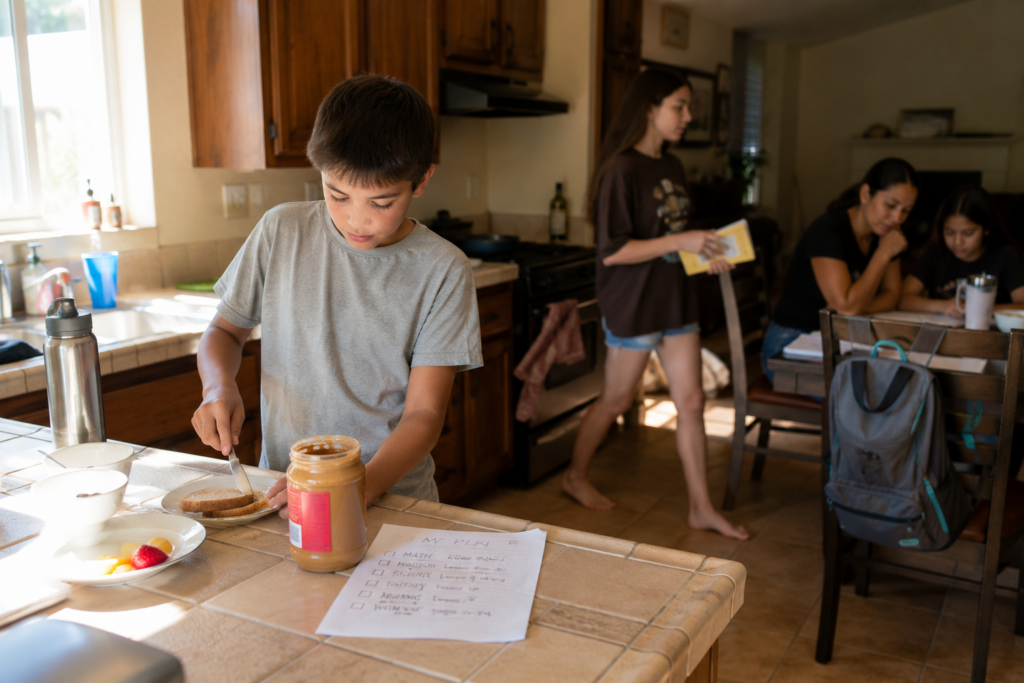
The work cycle includes structure. Older children often have a work plan that lists what needs to be completed during the week. They choose the order and timing, but the expectations are clear. Younger children may have a smaller set of choices that the adult has prepared.
Freedom within the work cycle is real, but it exists inside limits. Children choose how and when, within a framework the adult has thought through.
Protecting concentration when it appears
One of the most powerful things you can do is notice when your child is deeply focused, and leave them alone.
If your child has been absorbed in a project for an hour and lunch is ready, can lunch wait fifteen minutes? If they are writing a story with great focus, can the scheduled math lesson move to the afternoon?
These small choices teach children that their concentration is valuable. They also give children more of the experiences that build focus over time.
What a good work cycle looks like
An observer watching a healthy work cycle might see a pattern like this.
The child arrives, chooses a familiar piece of work and completes it. They choose something more challenging and work with real concentration for twenty or thirty minutes. Then comes the restless period: some wandering, chatting, maybe a snack. If left to settle, the child chooses a third piece of work and becomes deeply absorbed, often for a long stretch. At the end, they are calm and satisfied rather than tired.
This rhythm is common enough that many Guides learn to recognize it. The most important part is the third phase, which only arrives when the cycle is long enough and the restless period is not mistaken for the end.
The payoff
Families who start protecting long work periods often notice changes over a few weeks. Children who used to bounce between tasks begin staying with one thing longer. Work becomes more thorough. There are fewer complaints about being bored.
This is not magic. It is simply what happens when children are given the time they need to concentrate, and the trust to use it well.

Written by the Guides of Quantum Montessori, who teach students from preschool through high school in our homeschool, hybrid, distance learning and Learning Pod programs. Explore our programs.