What a shared dinosaur study can teach us about research, differentiation, and giving children work that actually matches where they are
From a Montessori Guide to Homeschool Parents
There is something about dinosaurs that can make an entire group of children suddenly have very strong opinions.
Someone already knows which dinosaur was fastest. Someone wants to know whether the Tyrannosaurus rex was really as terrifying as movies make it seem. Another child is interested in fossils rather than dinosaurs themselves. Someone wants to talk about extinction. Someone else has been waiting their entire academic career, apparently, for an adult to finally ask them to research a Spinosaurus.
I love studies like this because the enthusiasm is genuine, but I also love them for another reason. A shared topic gives parents a very clear picture of what differentiated learning can look like.
At Quantum Montessori, students can study the same broad subject without being given the same assignment. That distinction matters. If I am working with children across different ages, grade levels, academic abilities, and levels of independence, fairness does not require me to hand everyone an identical worksheet about dinosaurs. My job is to determine what meaningful work can grow from the subject for each student.
A dinosaur study can become vocabulary and classification for one child, a research project for another, scientific argument for another, mathematics for someone else, and an interdisciplinary investigation for an older student who is ready to connect paleontology with geology, anatomy, climate, evolution, or scientific uncertainty.
We can all begin in the same place.
We do not all have to end there.
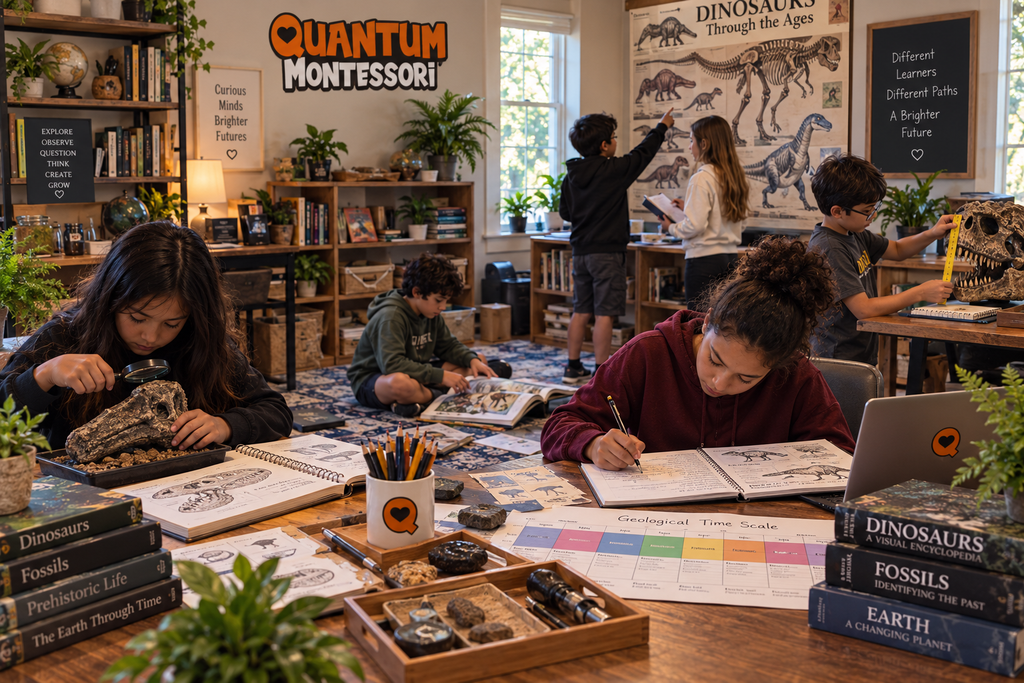
Our dinosaur display should be visible naturally in the environment, preferably behind glass, as part of the ongoing paleontology study rather than staged in the center of the photograph.
I am moving through the environment in a luxurious, sophisticated dinosaur-inspired Ms. Frizzle outfit, perhaps deep olive, camel, black, and bronze with subtle fossils, skeletal drawings, prehistoric botanicals, and gold details. A second Guide can be working with another student. Nobody looks at the camera. No dinosaur-party decorations, cartoon dinosaurs, signs, or identical worksheets.
We Start With Something We Can Wonder About Together
A shared lesson gives us common ground. I might introduce a particular dinosaur, fossil, geological period, adaptation, or scientific question to the entire group. We can look closely at evidence, learn vocabulary, examine what paleontologists believe, and talk about how scientists know anything about animals that disappeared millions of years before humans were here to observe them.
That last question is usually where things get interesting.
Children quickly discover that paleontology is not simply memorizing dinosaur names. Scientists are reconstructing the past from evidence. A bone has to be examined. Its location matters. Rock layers matter. Anatomy matters. Scientists compare structures across species. New discoveries can challenge older explanations. Sometimes researchers disagree. Sometimes a reconstruction changes because new evidence appears.
Now we have moved beyond “Which dinosaur is your favorite?”
We are talking about how knowledge is created.
For younger students, I may keep that idea very concrete. What can we observe? What do we think this structure was used for? How are these two animals alike or different? For older students, the same conversation can become much more sophisticated. What evidence supports this claim? Are there competing explanations? How confident are scientists? Has the scientific understanding of this animal changed?
That is differentiated learning before anyone has even begun a project. We are sharing an intellectual experience while changing the depth of the questions according to what each child is ready to do.
Research Should Become More Sophisticated as Children Grow
“Research dinosaurs” is not a useful assignment by itself.
A child can type a dinosaur’s name into a search engine, copy five facts, add a picture, and technically produce a research project without doing very much research at all. I want something different.
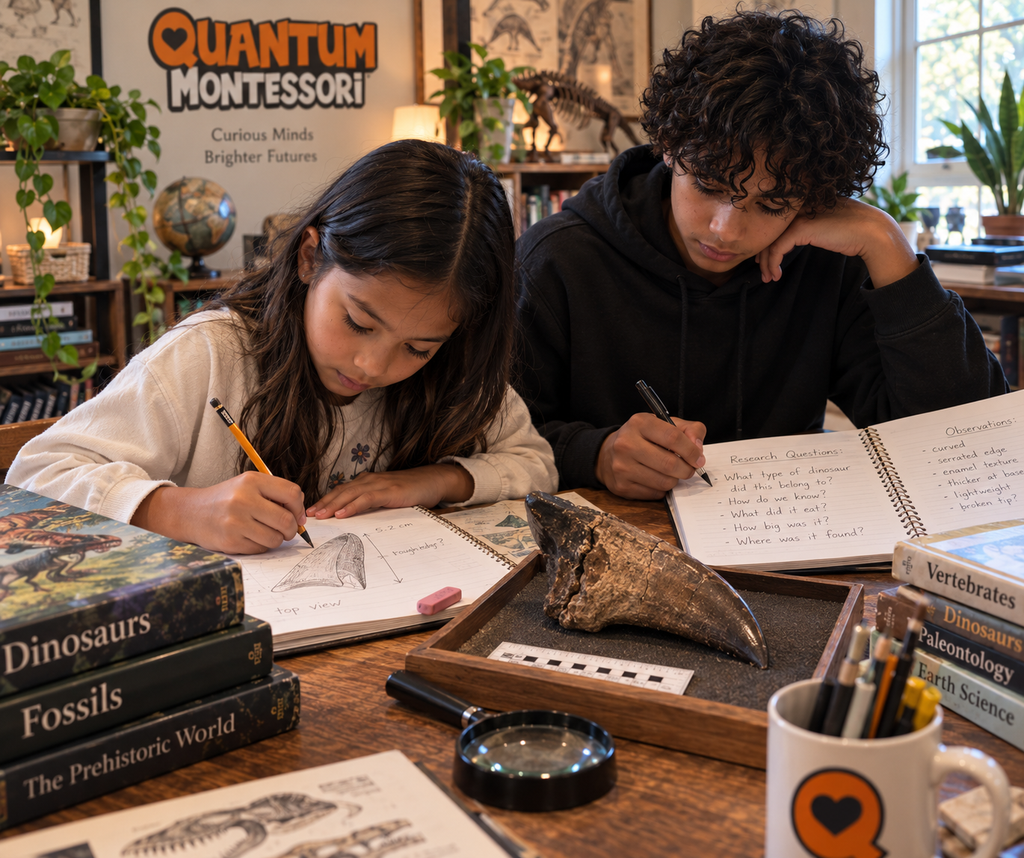
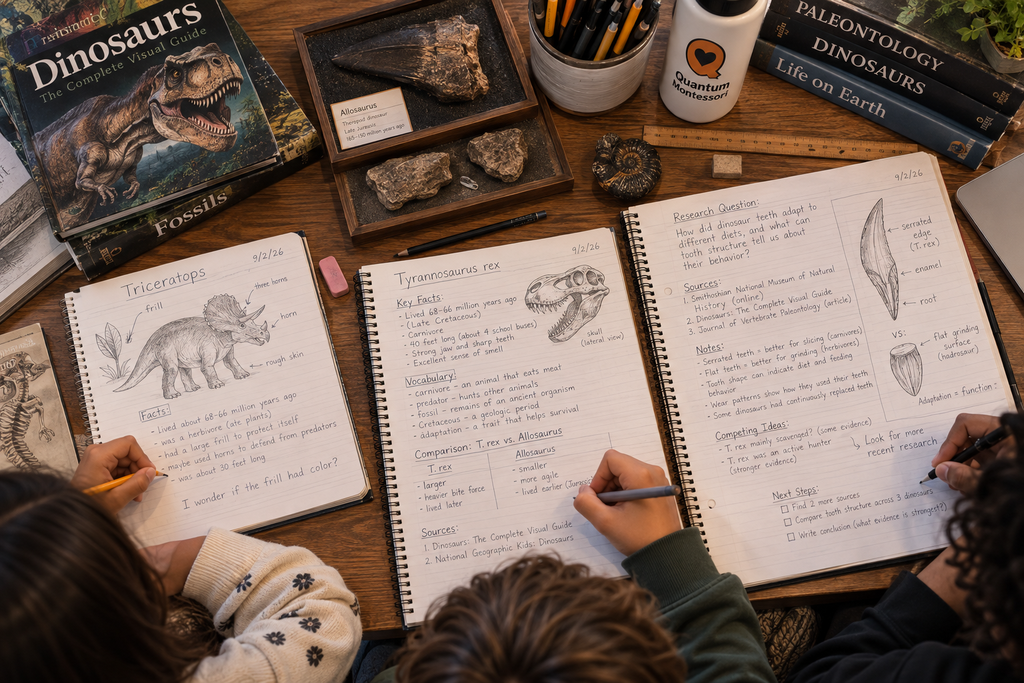
For a younger elementary student, research may begin with learning how to locate information in an age-appropriate physical book, identify important vocabulary, distinguish a useful fact from an interesting but unrelated detail, organize a few ideas, and explain those ideas in their own words. Their final work may include carefully labeled drawings, a short written explanation, a comparison, a simple timeline, or a small model they can explain.
An older elementary student can handle more. I may ask that student to consult multiple sources, organize research notes, compare species, investigate adaptations, consider habitat and geological period, and begin distinguishing evidence from assumption. Their project might include a more developed written report, scaled model, classification work, timeline, presentation, or an argument about what particular anatomical evidence suggests.
By middle school, I want the research question itself to become more demanding. A student might investigate competing explanations for a dinosaur’s behavior, examine how scientists infer locomotion from skeletal anatomy, compare mass estimates from different sources, study the relationship between geological evidence and extinction theories, or investigate how a particular fossil discovery changed scientific understanding.
The dinosaur is still fun.
The academic work has grown up.
The Project Should Tell Me Something About the Student
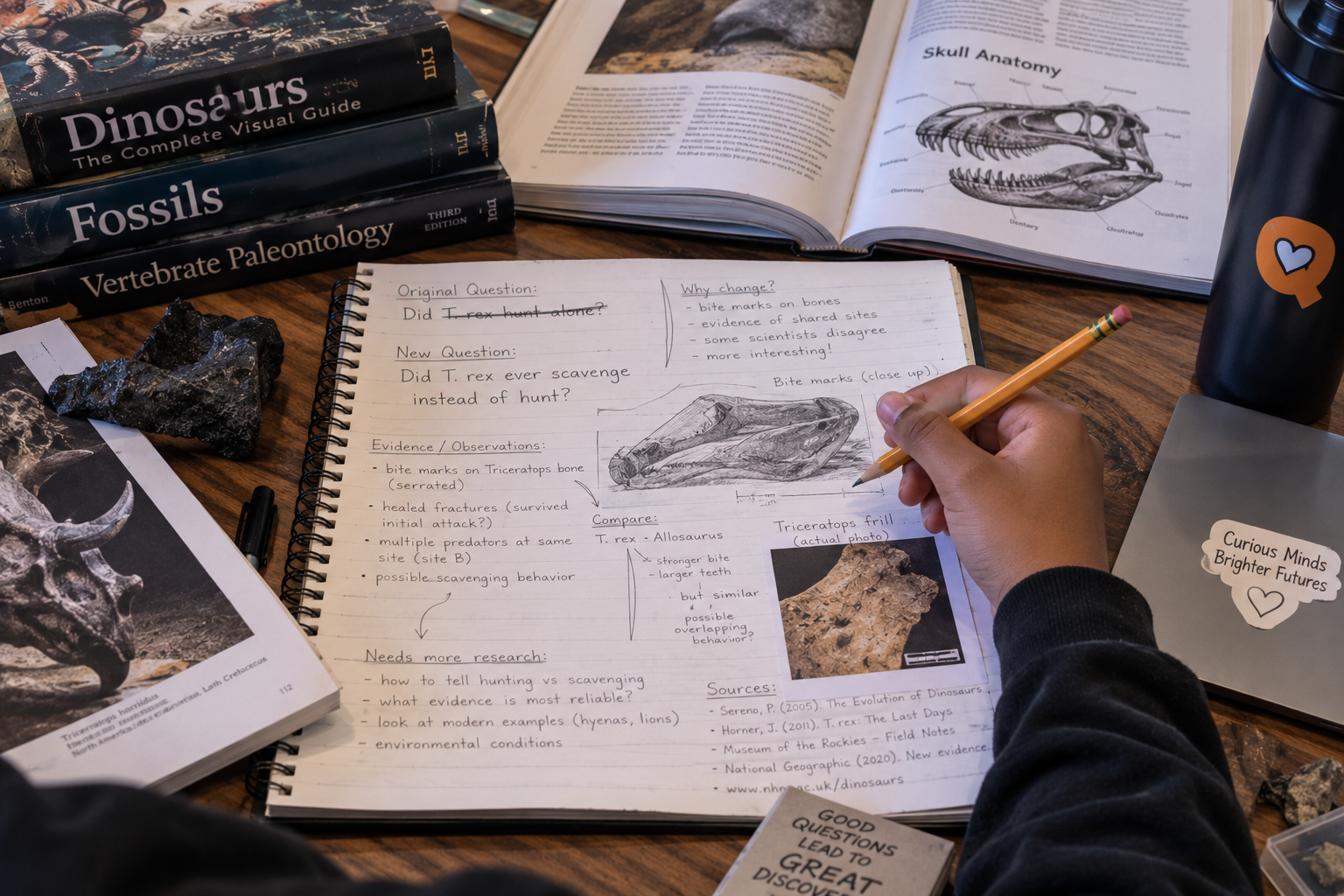
This is where project work becomes particularly valuable to me as a Montessori Guide. I am not only interested in whether a child can tell me facts about a dinosaur. I am observing how the student approaches the work.
Who immediately has ten questions? Who needs help narrowing one down? Who can find information but struggles to put it into their own words? Who creates an elaborate plan and then has difficulty beginning? Who wants to build before researching? Who reads deeply but avoids writing? Who finishes quickly because the work was genuinely easy, and who finishes quickly because they rushed? Who becomes absorbed enough to keep going beyond what I originally expected?
Those observations matter because the project is giving me information about the learner.
I can then adjust.
One child may need support organizing research. Another may need a more challenging question. A student who struggles with writing may be able to explain an incredibly sophisticated idea verbally, which tells me that the thinking and the written expression need different kinds of support. A child who is highly capable academically may need help with planning a multi-day project rather than harder content.
Differentiation is not simply assigning a third-grade dinosaur worksheet to a third grader and a sixth-grade dinosaur worksheet to a sixth grader.
I am looking at the grade level.
I am also looking at the child.

Dinosaurs Have a Wonderful Habit of Invading Every Subject
This is where I have fun with it.
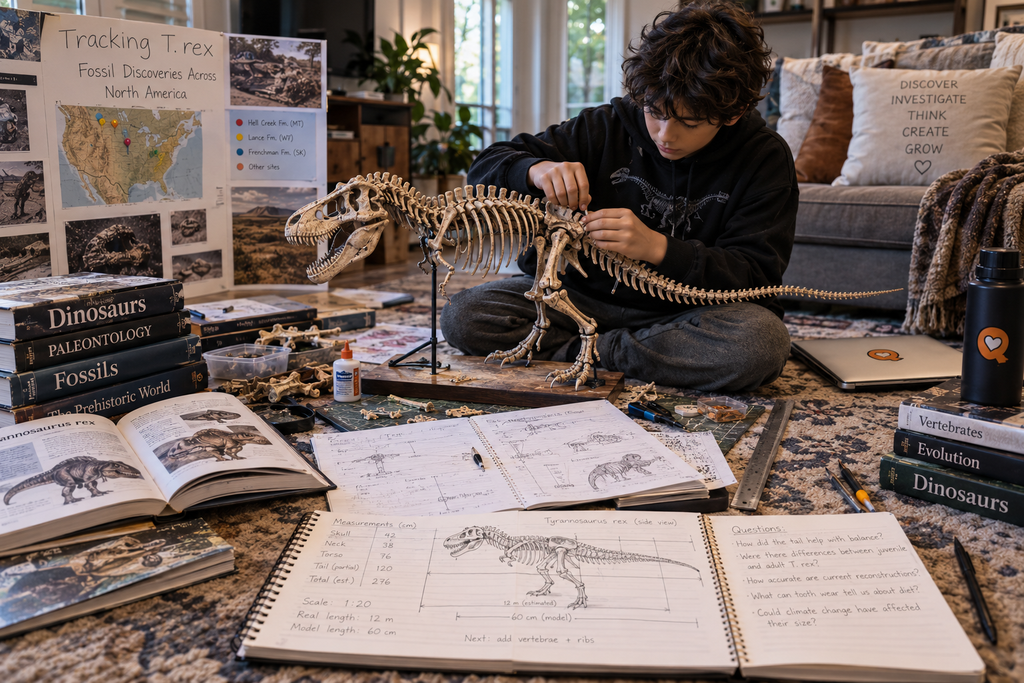
A dinosaur study can very easily begin wandering into mathematics. How large was this animal actually? Can we measure that distance outside? If a dinosaur was approximately thirty feet long, what does thirty feet look like in our environment? How does the length of one species compare with another? What happens when we create a scale drawing? How much uncertainty exists in estimates of mass?
Now we are measuring, estimating, calculating ratios, working with scale, comparing quantities, and interpreting data.
Science is already everywhere. We can explore anatomy, adaptations, food webs, ecosystems, geology, fossilization, plate tectonics, climate, extinction, scientific classification, and the difference between observation and inference.
Language is equally unavoidable. Students have to read increasingly complex nonfiction, develop vocabulary, take notes, summarize, compare sources, write explanations, formulate questions, discuss evidence, and present conclusions.
History enters through the history of paleontology itself. Who found particular fossils? Who received credit? How has our understanding changed? What did early reconstructions get wrong? How does scientific knowledge change over time?
Art can become scientific illustration, reconstruction, model making, or careful observational drawing rather than simply “draw a dinosaur.”
One subject has opened the door to an enormous amount of academic work without requiring us to pretend that every connection was accidental.
Not Every Student Needs the Same Final Product
I also do not need twenty-five identical dinosaur posters.
A final project should give a student a meaningful way to demonstrate what they have learned, and sometimes the form of that project can vary. One student may write particularly well and create a research paper with diagrams. Another may construct a model and provide a written scientific explanation. Someone may create a scaled skeletal reconstruction. Another student may develop a presentation around a controversial paleontological question. A younger child might create a carefully researched museum-style display with illustrations and short explanations.
The expectations still matter. Choice does not mean “do whatever you want.” If we are practicing research, I expect research. If writing is part of the academic objective, a beautiful model does not eliminate the writing. If students use sources, we need to talk about where information came from. If the project requires mathematics, the calculations should be visible.
But children can sometimes demonstrate the same underlying knowledge through work that does not look identical.
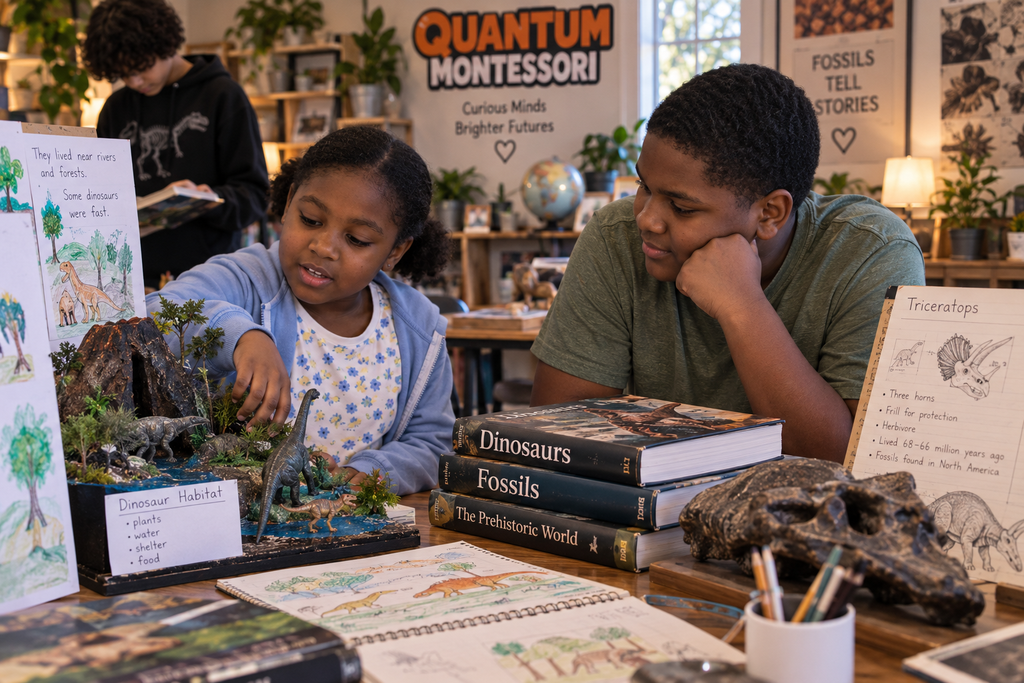
That is one of the reasons we plan to display projects from different age groups. I do not want parents or students to look at the younger work and see an inferior version of the older work. I want them to see development.
The younger child’s labeled reconstruction may represent exactly the level of observation, handwriting, vocabulary, and organization we are developing. An older student’s research display may show increasingly complex source work and written explanation. A middle school project may require synthesis, argument, evidence, and independence.
Placed together, those projects tell a story about how learning grows.
Younger Work Is Not Less Important Work
This deserves to be said explicitly because adults sometimes become so impressed by advanced-looking work that we forget what meaningful challenge actually means.
A beautifully written five-page report from a middle school student is not inherently more valuable than a younger child’s carefully researched page of observations if both children were working at the edge of what they could meaningfully do.
I am interested in growth.
Did the child have to think? Did they learn something they did not know? Did they practice a skill that is still developing? Did they become more independent? Did the work require care? Can they explain what they did? Did they encounter a problem and have to reconsider something?
Those questions tell me much more than whether the final product looks impressive to an adult.
It is also why I want students to see work across age groups. Younger children can see where skills eventually lead without being expected to perform there prematurely. Older students can recognize how much their own work has developed. Students can ask one another questions, notice different approaches, and discover that someone younger may have noticed something they completely missed.
The display becomes part of the learning rather than simply decoration on a wall.
Sometimes the Research Changes the Question
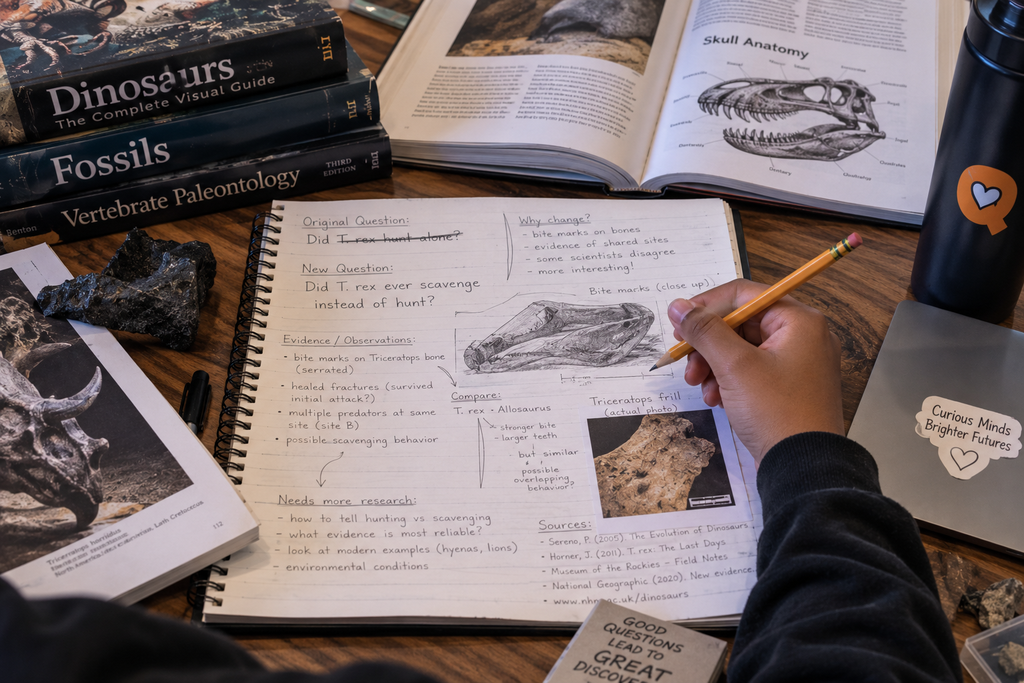
One of my favorite things that can happen during a project is when a child discovers that the question they started with is no longer the question they want to answer.
That is research.
A student begins by wanting to know how fast a particular dinosaur could run and discovers that scientists disagree about the estimate. Now the interesting question becomes why they disagree. Another child starts researching what a dinosaur ate and becomes fascinated by how scientists infer diet from teeth, jaws, fossilized stomach contents, or coprolites. Someone investigating extinction discovers that the story involves geology, atmospheric effects, climate, food webs, and a very large asteroid.
The project becomes deeper because information created another question.
I do not want to interrupt that simply because my original lesson plan said the child should be finished on Thursday.
There are still deadlines. Children need to learn how to finish things. We cannot pursue every interesting tangent forever. But there should be enough intellectual room for research to behave like research rather than a scavenger hunt for predetermined answers.
The Dinosaur Is the Invitation. The Thinking Is the Work.
Of course I want children to know things.
I want them to know when dinosaurs lived, how we classify them, what fossils can tell us, how ecosystems change, and why scientific evidence matters. Knowledge gives children something to think with. But the dinosaur study becomes much more valuable when factual knowledge is the beginning rather than the entire destination.
Can the student formulate a question?
Can they locate information?
Can they tell the difference between what scientists know and what they infer?
Can they compare sources?
Can they use mathematics when the research requires it?
Can they explain their thinking?
Can they revise an idea when evidence challenges it?
Can they complete a project with increasing independence?
Those are abilities children will use long after they have forgotten the estimated length of a particular dinosaur.
That is why I enjoy teaching a shared subject across ages. Differentiated learning allows us to have the excitement of a community studying something together without pretending that every member of that community needs identical work.
At Quantum Montessori, one dinosaur can walk into the lesson and cause quite a bit of academic trouble.
Before long, someone is measuring thirty feet across the yard. Someone is arguing about feathers. A student has three books open because two sources disagree. Another has decided the original research question was boring and found a better one. There are drawings, calculations, fossils, timelines, half-built models, revised paragraphs, and a Guide trying not to look too delighted that the lesson has escaped the boundaries of a single subject.
That is exactly the kind of trouble I like.
Because somewhere between Which dinosaur are we studying? and How could scientists possibly know that?, children stop simply collecting facts.
They start doing the work of researchers.
Leave a Reply