Curriculum & Work Plans
Keeping a Portfolio That Shows Real Growth
A good portfolio is not a pile of finished worksheets. It is a story of how a child has changed over a year.
At the end of a homeschool year, many families face a stack of papers. Worksheets, drawings, writing assignments, math pages. Some go in a box. Some go in the recycling. Very few tell much of a story.
A thoughtful portfolio can do much more. It can show how a child has grown, what they have explored, where they have struggled, and what they have accomplished. It can be useful for record-keeping, meaningful for the child, and genuinely moving for the family.
Why keep a portfolio
Portfolios serve several purposes.
Documentation. Depending on where you live, homeschool families may need to document learning. A portfolio provides evidence of educational progress.
Reflection. Looking back at earlier work helps children see how much they have grown. A child who struggled with handwriting in September and writes fluently in May can see that change in their own pages.
Planning. Portfolios help parents and Guides identify patterns, strengths, and areas that need attention.
Celebration. A well-kept portfolio is a record of a year of learning that families often treasure for years.
Choose samples, not everything
A portfolio does not need to include every piece of work. In fact, it is more useful when it does not.
Instead, select representative samples. A few pieces from the beginning of the year, middle, and end in each subject. Work that shows a new skill. Work the child is especially proud of. Work that reveals a struggle.
Quality over quantity makes the portfolio easier to review and more meaningful.
Include process, not only products
Finished work is only part of the story. Process tells the rest.
Consider including:
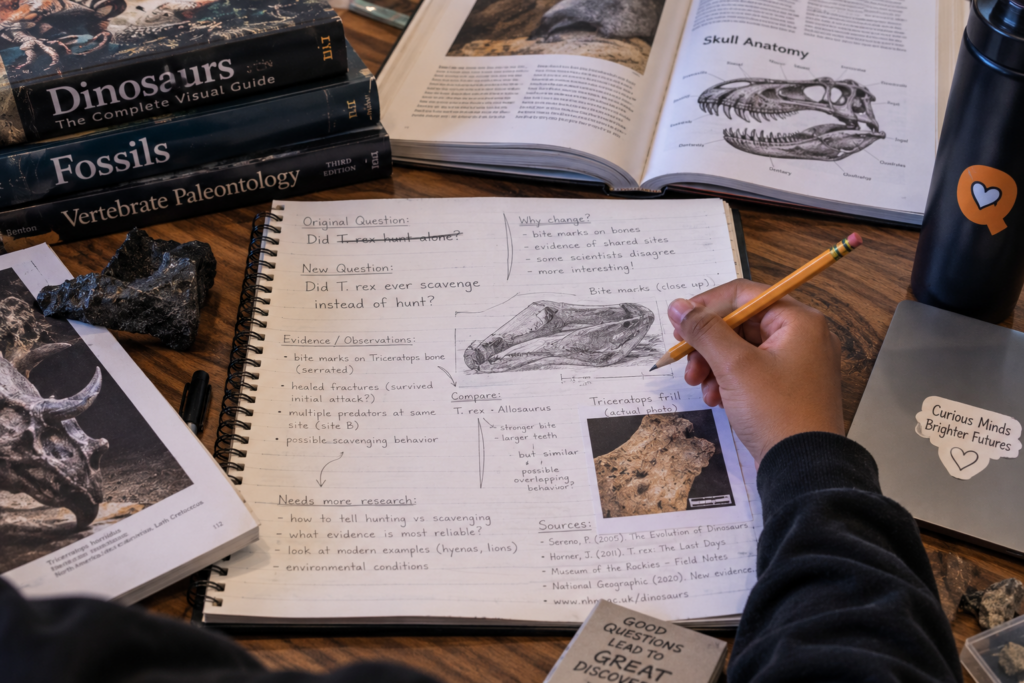
- Drafts alongside final versions, showing revision.
- Photos of hands-on projects, experiments, and building work.
- Notes from the child about what they learned or found difficult.
- Observations from the parent or Guide.
- Lists of books read.
- Records of field trips and real-world experiences.
- Photos of Practical Life work, like cooking, gardening, or building.
These capture learning that would otherwise be invisible.
Date everything
A simple habit makes portfolios dramatically more useful: date every piece of work. Without dates, it becomes impossible to see growth over time.
A date stamp, a sticker, or a quick handwritten note in the corner is enough.
Involve the child
Portfolios become much more meaningful when children help create them.
Ask your child to choose pieces they are proud of. Ask them to write or dictate a short reflection: What did I learn? What was hard? What am I proud of? What do I want to work on next?
Older children can manage most of their own portfolio, with periodic check-ins. This builds the habit of reflecting on their own learning, a skill that serves students well throughout life.
Organize simply
Portfolios can take many forms. A binder with sections for each subject. An accordion file organized by month. A box for physical projects. A digital folder with scanned work and photos.
Choose a system that you will actually maintain. A simple binder kept consistently is better than an elaborate system abandoned in October.
Some families add to the portfolio weekly, choosing one or two pieces each Friday. Others do it monthly. Regular small additions are easier than trying to assemble everything at year’s end.
Review together
Periodically sit down with your child and look through the portfolio together. Every few months is often enough.
Notice growth together. “Look at your writing from September. Now look at this. What do you notice?” These conversations help children see themselves as learners who grow through effort.
Portfolios in our programs
In our programs, students build academic portfolios that reflect their work across the year. Guides help students select meaningful work and reflect on their progress. Families can see growth clearly, and students develop ownership of their learning.
For families homeschooling independently, the same principles apply. A portfolio is not just a record for someone else. It is a tool for understanding your child, and for helping your child understand themselves.
A simple portfolio structure
If you want a structure to start from, this one works well for many families.
Opening page. A photo of your child at the start of the year, along with a short interview: favorite book, what they want to learn, what they find hard. Repeat the interview at the end of the year and place it at the back. The comparison is often striking.
One section per subject. In each, place three to five dated samples across the year. Include at least one piece that shows a struggle and one that shows a breakthrough.
Reading log. A running list of books read, with dates. Even a simple list becomes impressive by June.
Projects and experiences. Photos and short notes about field trips, experiments, building projects, performances and community work.
Practical Life. Photos of real work: cooking, caring for animals, repairing something, helping a neighbor.
Reflections. Short notes from your child, written or dictated, about what they learned and what they are proud of.
Parent or Guide notes. Brief observations of growth across the year.
This structure takes only a few minutes a week to maintain, and it produces a record that is useful for documentation, planning and celebration.
The story of a year
At the end of a year, a good portfolio tells a story. Here is where we started. Here is what we explored. Here is what was hard. Here is what changed.
That story is worth keeping.

Written by the Guides of Quantum Montessori, who teach students from preschool through high school in our homeschool, hybrid, distance learning and Learning Pod programs. Explore our programs.