Curriculum & Work Plans
Teaching Kids to Research Before They Google
Finding an answer in two seconds is not the same as understanding it. Here is how we teach real research skills to elementary and middle school students.
Ask a child today how to find out about something, and the answer is usually immediate. “Google it.”
That instinct is not wrong. Search tools are powerful, and children should learn to use them well. But typing a question and reading the first result is not research. It is retrieval. And retrieval alone does not build understanding, judgment, or the ability to evaluate what you find.
Research is a skill. Like other skills, it needs to be taught.
What research really involves
Real research includes several steps that happen before, during, and after searching.
Asking a good question. “What are volcanoes?” is a starting point. “Why do some volcanoes erupt explosively while others ooze lava slowly?” is a research question.
Knowing what you already know. Before searching, a researcher considers what they already understand and what they need to find out.
Choosing sources. Not all information is equally reliable. A researcher considers where information comes from and why it might be trustworthy or not.
Reading carefully. Skimming for a quick answer is different from reading to understand.
Taking notes in your own words. Copying sentences is not learning. Summarizing requires understanding.
Comparing sources. Do different sources agree? If not, why?
Drawing conclusions. What does the evidence suggest? What is still uncertain?
Sharing what you learned. Explaining, writing, or presenting findings to others.
Start with books
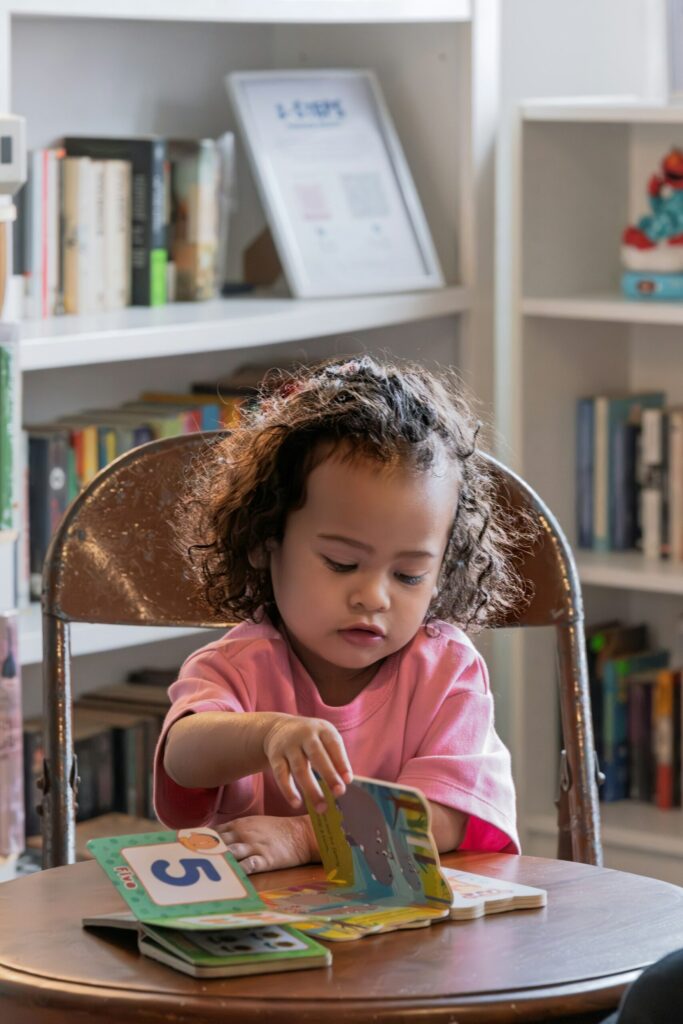
For younger children especially, books are an excellent place to begin research. Books are organized, edited, and written for a specific audience. They encourage sustained reading rather than jumping between fragments.
Teach children to use tables of contents, indexes, glossaries, and headings. These features help them find information efficiently and understand how information is organized.
A trip to the library with a research question can be a wonderful lesson in itself.
Teach note-taking
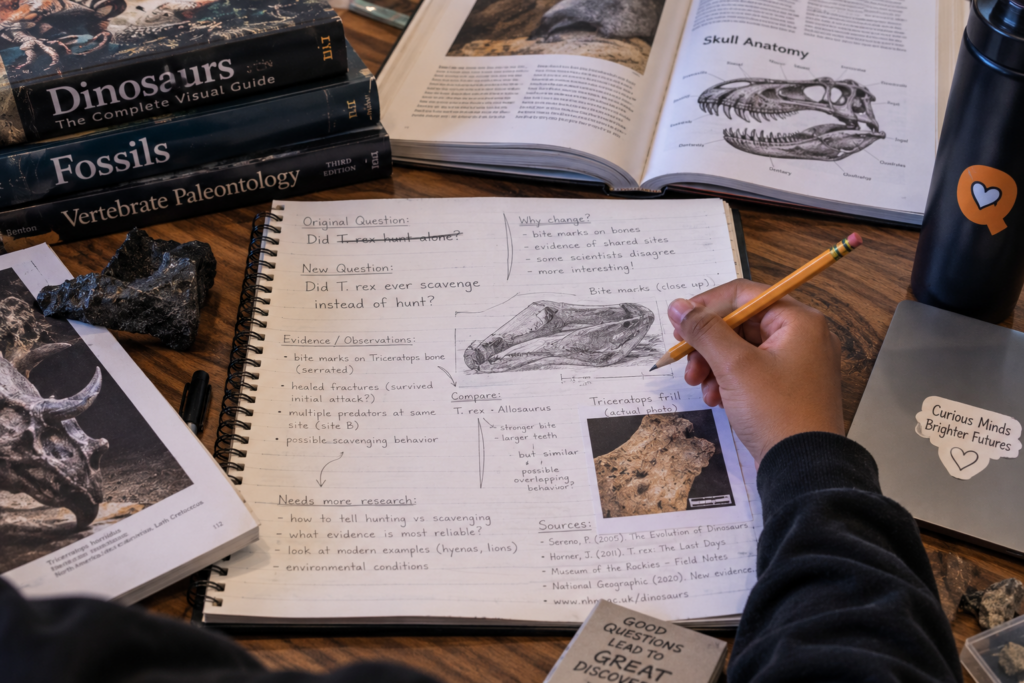
Note-taking is where much of the real learning happens. When children have to put information in their own words, they have to understand it.
A simple method for younger students: read a short section, close the book, and write down what you remember in a few words. Then check the book to see if you got it right.
Older students can learn more structured note-taking, such as organizing notes by subtopic or using index cards that can be rearranged when writing.
Then introduce online research thoughtfully
When children begin researching online, they need specific guidance.
Who wrote this? Is it an organization, an expert, a company, or an anonymous person?
Why was it written? To inform, to sell, to persuade, to entertain?
When was it written? Is the information current enough?
Can I find the same information elsewhere? Reliable facts usually appear in multiple trustworthy sources.
Practicing these questions together, looking at real websites and talking about them, builds critical judgment that children will need for the rest of their lives.
The role of AI tools
Many children now have access to AI chat tools that can produce instant answers. These tools can be useful, but they raise new questions about research. Answers can sound confident while being wrong. They often do not show where information came from.
Older students benefit from learning to treat these tools the way they would treat any source: as a starting point to check against reliable references, not a final authority. Families and Guides can talk openly about when such tools are appropriate and when the student needs to do the thinking themselves.
Research in Montessori elementary
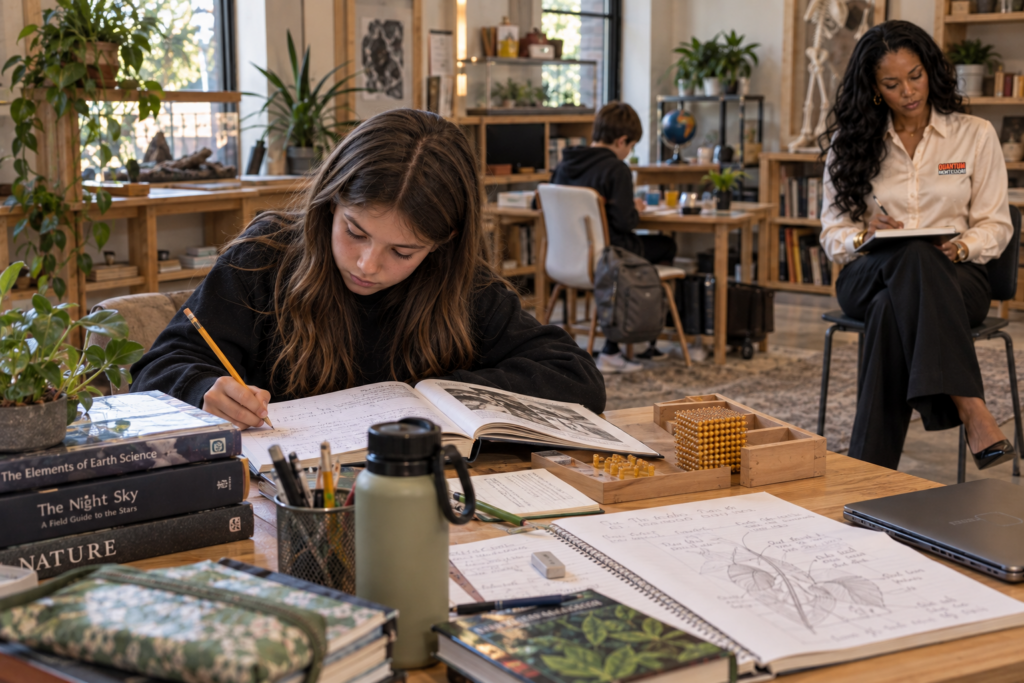
In Montessori elementary classrooms, research is a central part of learning. After a Great Lesson or a presentation sparks curiosity, children often choose topics to investigate in depth. They research, take notes, create reports or presentations, and share with peers.
This kind of research is driven by genuine curiosity. Children are not finding answers to someone else’s questions. They are pursuing their own.
Small projects, often
Research skills develop through practice. Frequent small research projects build skills more effectively than a single large report once a year.
A question at breakfast can become a ten-minute research project. A walk outside can lead to identifying a bird and learning about its habits. A historical novel can spark a short investigation into the real events behind the story.
Each small project is a chance to practice asking questions, finding information, evaluating sources, and explaining what you learned.
A first research project
If your child has never done a research project, start small. Here is a simple format for children around eight to ten years old.
- Choose a question. Something your child genuinely wonders about. “How do bees make honey?”
- Write what you already know. Two or three sentences.
- Find two books. Use the library catalog together.
- Take notes. Read a section, close the book, write three facts in your own words.
- Check one website together. Discuss who wrote it and whether it agrees with the books.
- Write a short report. One paragraph for each main idea, plus a sentence about what surprised you.
- Share it. Read it to the family, present it at dinner, or make a small poster.
The whole project can take a week of short sessions. By the end, your child has practiced the full research cycle in a manageable way.
Understanding, not just answers
The goal of research is not simply to find answers. It is to understand, to think critically about information, and to build knowledge that connects.
Children who learn to research well become adults who can investigate questions independently, evaluate claims carefully, and keep learning long after their formal education ends.

Written by the Guides of Quantum Montessori, who teach students from preschool through high school in our homeschool, hybrid, distance learning and Learning Pod programs. Explore our programs.