Literacy & Learning
Handwriting Still Matters
In a world of keyboards and voice typing, it is fair to ask why children should still write by hand. The research and our classroom experience both point the same way.
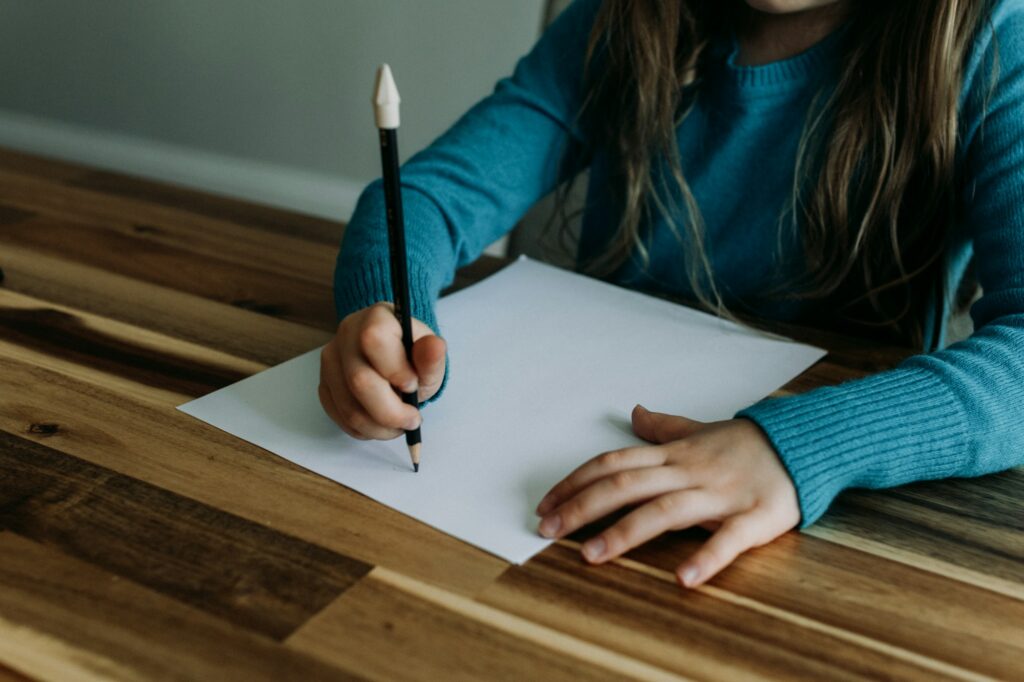
“Do they really need to write by hand? Everything is typed now.”
We hear this from parents fairly often, especially from those with older children who find handwriting slow and frustrating. It is a reasonable question. Most adult writing happens on keyboards and phones. Why spend time on something that seems to be disappearing?
Our answer is that handwriting is not only about producing text. It is about how children learn, think, and remember.
Writing by hand supports learning
When children write letters by hand, they engage motor, visual, and cognitive systems together. Forming each letter requires attention to shape, size, and sequence. This physical process appears to strengthen letter recognition and early reading.
For older students, there is evidence that taking notes by hand can support understanding and memory better than typing. Writing by hand is slower, which forces the writer to summarize and process ideas rather than transcribe them word for word.
In other words, the slowness of handwriting is not only a cost. It can be part of the benefit.
Montessori starts early
In Montessori primary classrooms, preparation for writing begins long before children hold a pencil to write words.
Children trace sandpaper letters with their fingers, feeling the shape of each letter while saying its sound. They use metal insets to practice controlled pencil movements. They build hand strength and coordination through Practical Life activities like pouring, spooning, and squeezing sponges.
By the time children begin writing words, their hands are prepared. Writing often comes with surprising ease, and many children are writing before they are reading fluently.
Handwriting and composition
There is another reason handwriting matters. When handwriting is slow and effortful, it uses up mental energy that a child needs for composing ideas.
A child who struggles to form letters may have wonderful stories in their head but produce only a few sentences on paper. Their writing ability appears weaker than it really is, because the mechanics are getting in the way.
As handwriting becomes more automatic, children have more attention available for the content of what they write. This is one reason continued handwriting practice through the elementary years matters.
What about cursive?
Many Montessori programs introduce cursive early, sometimes before print. The reasoning is that cursive letters flow naturally from one to the next, and the continuous movement can feel more natural for young hands.
Families vary in their approach, and both print and cursive can serve children well. What matters most is that children develop fluent, legible handwriting that does not slow them down.
When handwriting is hard
Some children find handwriting genuinely difficult. Their letters are uneven, their hands tire quickly, and writing becomes a source of frustration.
If this describes your child, a few things can help:
- Check the basics. Is their pencil grip comfortable? Are they sitting at a table that fits their body? Is their paper positioned well?
- Build hand strength. Play dough, clay, tongs, clothespins, gardening, and climbing all strengthen the hands.
- Practice briefly but often. Five minutes of careful practice each day is more effective than one long, frustrating session.
- Separate handwriting practice from composition. Let them dictate stories while you scribe, or type longer compositions, while still practicing handwriting separately.
- Seek evaluation when needed. Persistent difficulties may be worth discussing with an occupational therapist, especially if they affect many areas of fine motor work.
A place for keyboards too
None of this means children should never type. Keyboarding is an important skill, and older students will do much of their writing digitally.
The goal is balance. Younger children benefit from primarily handwritten work. As children grow older, typing can take a larger role, especially for longer compositions. But handwriting should not disappear. Notes, drafts, math work, journals, and letters all offer continued practice.
Short daily practice that works
Handwriting improves most with short, frequent, focused practice. A few ideas that keep it from becoming a chore:
- Copywork. Copy a short, beautiful passage, such as a line of poetry or a favorite sentence from a book. Focus on careful letter formation.
- Letter of the week. Concentrate on one letter or letter pair that is giving trouble. Practice it in isolation, then in words.
- Real writing for real readers. Thank-you notes, postcards to relatives, labels for a science display, a shopping list. Children often write more carefully when someone will read it.
- Journals. A few sentences each day in a journal builds fluency over time.
- Varied tools. Chalk on a sidewalk, a finger in sand, a brush with water on a chalkboard. These build the motor pattern without the pressure of pencil and paper.
Five to ten minutes a day is enough for most children. The goal is steady improvement, not perfection.
Beyond practicality
There is something else about handwriting that is harder to measure. A handwritten letter feels personal. A child’s journal in their own handwriting becomes a record of who they were at that age. A carefully written final copy can be a source of real pride.
Handwriting connects children to their own words in a way typing does not. It asks them to slow down, to form each letter, and to leave a mark that is unmistakably their own.
That seems worth holding onto.

Written by the Guides of Quantum Montessori, who teach students from preschool through high school in our homeschool, hybrid, distance learning and Learning Pod programs. Explore our programs.