Montessori Education
The Teenager Who Wants Real Responsibility
Montessori called the adolescent "the social newborn." What teenagers need most is the chance to do work that genuinely matters to other people.

Teenagers have a reputation for not wanting responsibility. They sleep late, avoid chores, and seem allergic to anything that looks like work.
But watch what happens when a teenager is given responsibility that is real. Not “clean your room,” but “you are in charge of the family’s garden this summer.” Not “do this assignment,” but “the local food bank needs someone to design a system for tracking donations. Can you build one?”
Often, a different young person appears. Focused. Capable. Proud.
The adolescent as social newborn
Dr. Montessori described the adolescent as a “social newborn.” Just as a newborn baby is entering the physical world, an adolescent is entering the social world of adults.
This stage brings an intense need to understand society, find a place in it, and contribute to it. Adolescents want to know how the world works, and they want to be part of how it works.
Montessori believed that traditional schooling often fails adolescents at this stage. It keeps them in a world of exercises and evaluations, separate from the real economy and community. She proposed instead that adolescents should experience real work, real commerce, and real responsibility.
Why real responsibility matters
When adolescents do work that matters to other people, several things happen.
They develop competence. Real work requires real skills. Planning, problem-solving, communication, follow-through.
They develop confidence. Not the fragile confidence that comes from praise, but the solid confidence that comes from having actually done something difficult.
They connect academics to purpose. A teenager running a small business suddenly cares about math. A teenager advocating for a cause suddenly cares about writing persuasively.
They develop a sense of belonging. Contributing to a community makes adolescents feel they are part of it.
Ideas for real responsibility
Homeschooling offers unusual freedom to give teenagers meaningful work. A few possibilities:
- Running a small business. Baking, crafts, lawn care, pet sitting, tutoring, photography. The business should be real, with real customers, costs, and income.
- Regular volunteering. Not one-off service projects, but ongoing commitments where the teen becomes a reliable part of an organization.
- Managing a household system. Groceries, meal planning, budgeting for an expense category, maintaining a garden, caring for animals.
- Apprenticeships and mentorships. Spending regular time with an adult professional in a field that interests them.
- Community projects. Organizing a neighborhood cleanup, a book drive, a fundraiser, or an event.
- Teaching younger children. Leading a club, coaching a sport, tutoring a younger sibling or neighbor.
Responsibility with support
Giving teenagers real responsibility does not mean leaving them alone with it. They still need guidance, especially at first.
Help them plan. Ask questions that help them anticipate problems. Check in regularly. Let them make mistakes, but be available to help them reflect and recover.
The goal is gradual release. As they demonstrate capability, step back further.
When it goes wrong
Real responsibility includes real failure. The bake sale might lose money. The volunteer shift might get forgotten. The garden might wither in a heat wave.
These experiences are valuable. They teach accountability in a way that no lecture can. The key is to help the teen reflect without shame. What happened? What would you do differently? What can you do now to make it right?
Adults learn from their failures. Adolescents can, too, when they are given the chance.
Academics in context
Some parents worry that focusing on real-world work will take time away from academics. In practice, the two often reinforce each other.
A teen running a business practices mathematics, writing, and economics. A teen volunteering at a nature center studies biology and ecology. A teen organizing a community event practices communication, planning, and leadership.
Academic coursework remains important, especially as students approach high school graduation and college preparation. But when academic skills have visible purpose, teens tend to engage with them more seriously.
One family’s example
A family we worked with had a fourteen-year-old who seemed to have lost interest in everything. Schoolwork was done slowly and reluctantly. Most days were spent in his room.
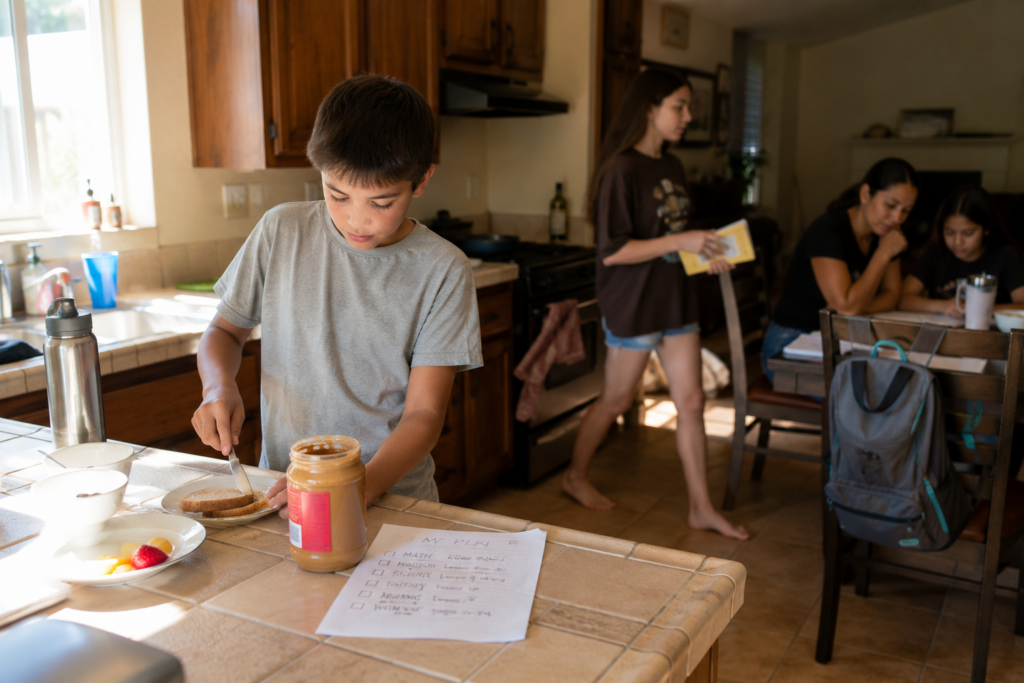
His parents decided to try something different. They asked him to take over planning and cooking dinner two nights a week, with a fixed grocery budget. He would plan the menu, write the list, do the shopping with a parent and cook.
The first few weeks were rough. One dinner was very late. Another went well over budget. One was, by his own admission, not very good.
But something shifted. He began reading recipes with real attention. He started comparing prices and calculating cost per serving. He asked his grandmother for a family recipe and learned the story behind it. By the end of the semester he was cooking three nights a week and had started a small notebook of his own recipes with notes on cost and preparation time.
His parents noticed that his academic work improved, too. Not because cooking taught him history or algebra directly, but because he had rediscovered the experience of being capable and trusted. That feeling carried into other parts of his day.
Not every teenager will respond the same way. But many will surprise you when the responsibility is real.
Trusting them
The hardest part for many parents is trust. It is easier to do things ourselves. It is faster, and the result is more predictable.
But teenagers need to be trusted with things that matter. They need to see that the adults around them believe they are capable. Very often, they rise to meet that belief.

Written by the Guides of Quantum Montessori, who teach students from preschool through high school in our homeschool, hybrid, distance learning and Learning Pod programs. Explore our programs.