From a Montessori Guide to Homeschool Parents
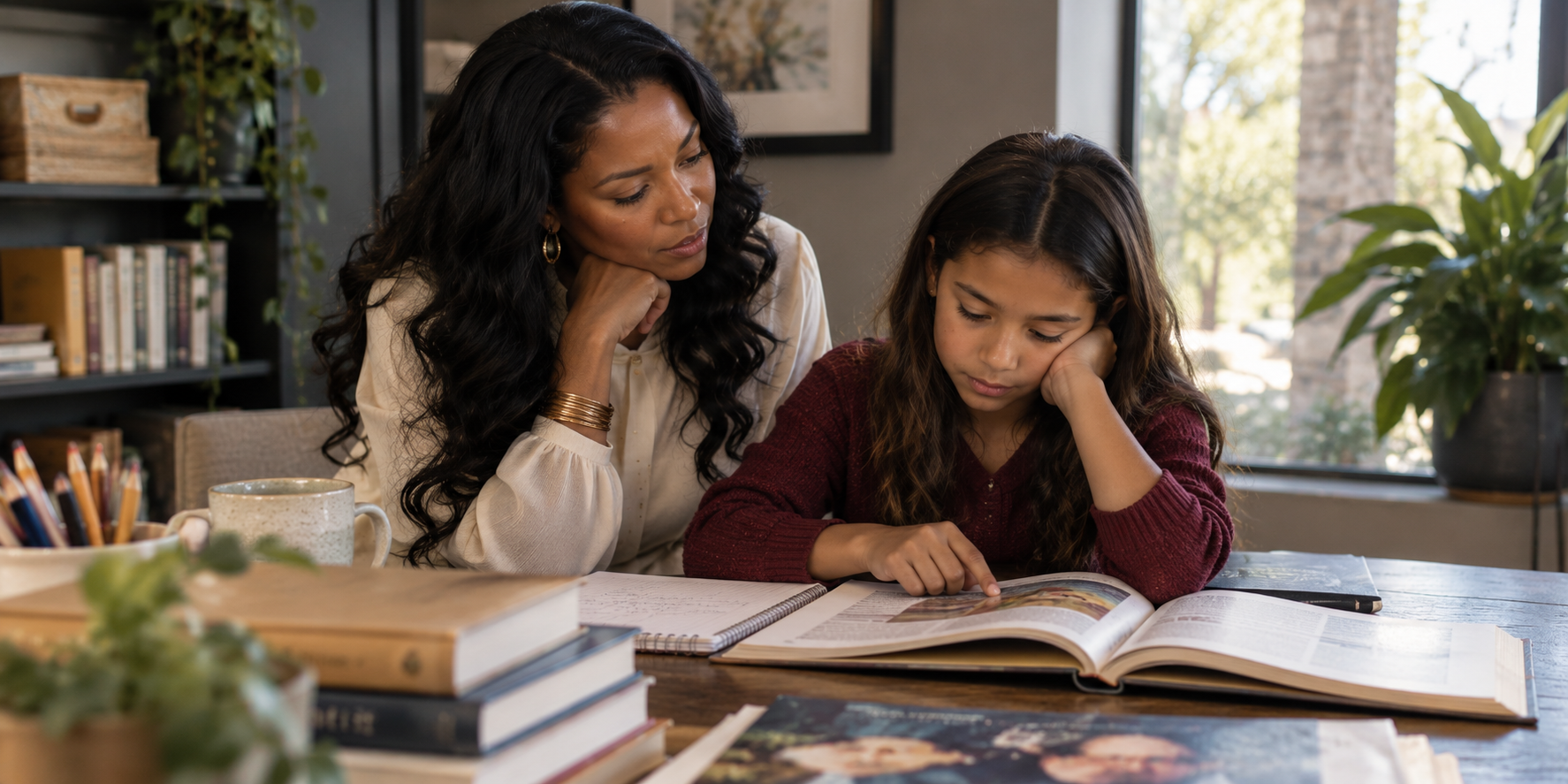
There is a moment I have experienced with students more times than I can count. A child reads a passage aloud to me beautifully. The words are pronounced correctly, the pace sounds appropriate, and nothing about the reading immediately suggests that the child is struggling. Then we finish, I close the book or ask the child to look up from the page, and I say, “Tell me what you just read.”
Sometimes there is a long pause. Sometimes the answer is, “I don’t know.” Other times, the child remembers one small detail but cannot explain the main idea, tell me why something happened, describe what a character was trying to accomplish, or put the information into their own words.
This is one reason reading comprehension deserves just as much attention as reading fluency. A child can become quite skilled at recognizing and pronouncing words without fully understanding the ideas those words communicate.
For homeschool parents, this can be particularly difficult to notice. We hear our children reading aloud and think, They’re reading well. And they may be. But fluent reading is only one part of becoming a strong reader.
Understanding is another.
Reading the Words Is Only the Beginning
When children first learn to read, much of their energy goes into decoding. They are learning letter sounds, recognizing patterns, blending sounds, identifying familiar words, and eventually reading sentences with increasing fluency.
As children grow, however, something important changes. They are no longer only learning how to read. They are increasingly expected to learn by reading.
By upper elementary and middle school, reading is woven into almost everything a child does academically. Students read literature and informational texts in English Language Arts. They read about historical events in social studies. They read explanations, procedures, and observations in science. They have to interpret written directions and make sense of math word problems. They conduct research and eventually compare information from multiple sources.
All of this depends on reading comprehension.
A child needs to understand vocabulary, identify important information, follow a sequence of ideas, remember what happened earlier, recognize cause and effect, make inferences, connect new information to prior knowledge, and determine what an author is actually trying to communicate.
That is very different from simply being able to pronounce the words on the page.
Reading Comprehension Often Reveals Itself in Conversation
One of the simplest ways I learn about a student’s reading comprehension is through conversation.
I don’t necessarily begin with a worksheet or a list of comprehension questions. I often start with something much simpler: “Tell me about what you just read.”
It is an intentionally open question because I want to see what the child does with the information without my organizing it for them first.
Can the child explain the main idea? Can they tell me what happened in a reasonable sequence? Do they understand why a character behaved a certain way? Can they explain something they learned from an informational text? Can they connect something from the beginning of a chapter to something that happened later?
Most importantly, can they explain what they read in their own words?
That last piece tells me quite a bit.
A child may be able to locate a sentence in the text and repeat it back to me. That is a useful skill, particularly when we are learning to find textual evidence, but it does not automatically demonstrate understanding. I also want to know whether the child can process the idea and explain what it means.
This is where a simple conversation can reveal things that a reading level alone may not.

“I Don’t Know” Is Not the End of the Conversation
When a student tells me, “I don’t know,” after reading something, I don’t immediately assume the child wasn’t paying attention or didn’t try.
I become curious about where understanding broke down.
Perhaps there were several unfamiliar vocabulary words in the passage. Maybe the child understood each sentence individually but struggled to connect those sentences into one larger idea. The child may have forgotten important information from an earlier chapter or may not have enough background knowledge to make sense of the new information.
Sometimes a student reads too quickly and never stops long enough to think about what the words mean. Another student may read so slowly and laboriously that so much attention is devoted to decoding that there is little mental energy left for comprehension.
And sometimes a child understands the text perfectly well but has difficulty organizing an answer verbally or in writing.
Those are not the same problem.
That distinction matters because good teaching is not simply about identifying that a child got an answer wrong. We need to understand why.
This is one of the reasons observation is so central to the Montessori approach. The child’s work gives us information. Their mistakes give us information. Their questions, hesitations, strategies, frustrations, and successes all tell us something about what they understand and what they may need next.
Vocabulary and Reading Comprehension Are Closely Connected
Vocabulary is another area I watch carefully.
Imagine that a child reads this sentence:
“The villagers were apprehensive about approaching the unfamiliar structure.”
A capable reader may pronounce every word correctly. But if the child does not understand apprehensive, the meaning of the sentence changes considerably.
As texts become more sophisticated, children encounter more words that may not be part of their everyday vocabulary. They also encounter familiar words used in unfamiliar ways, academic language, figurative language, technical terminology, and words whose meaning has to be determined through context.
This is why vocabulary cannot be treated as something separate from reading comprehension.
Children need opportunities to notice interesting words, talk about them, determine their meaning through context, look them up when necessary, write them, and eventually use them themselves.
That doesn’t mean interrupting a good story every thirty seconds for a vocabulary lesson. We don’t want to make reading so laborious that children stop enjoying it.
But we also shouldn’t assume that because a child can say a word, they understand it.

Children Need to Talk About What They Read
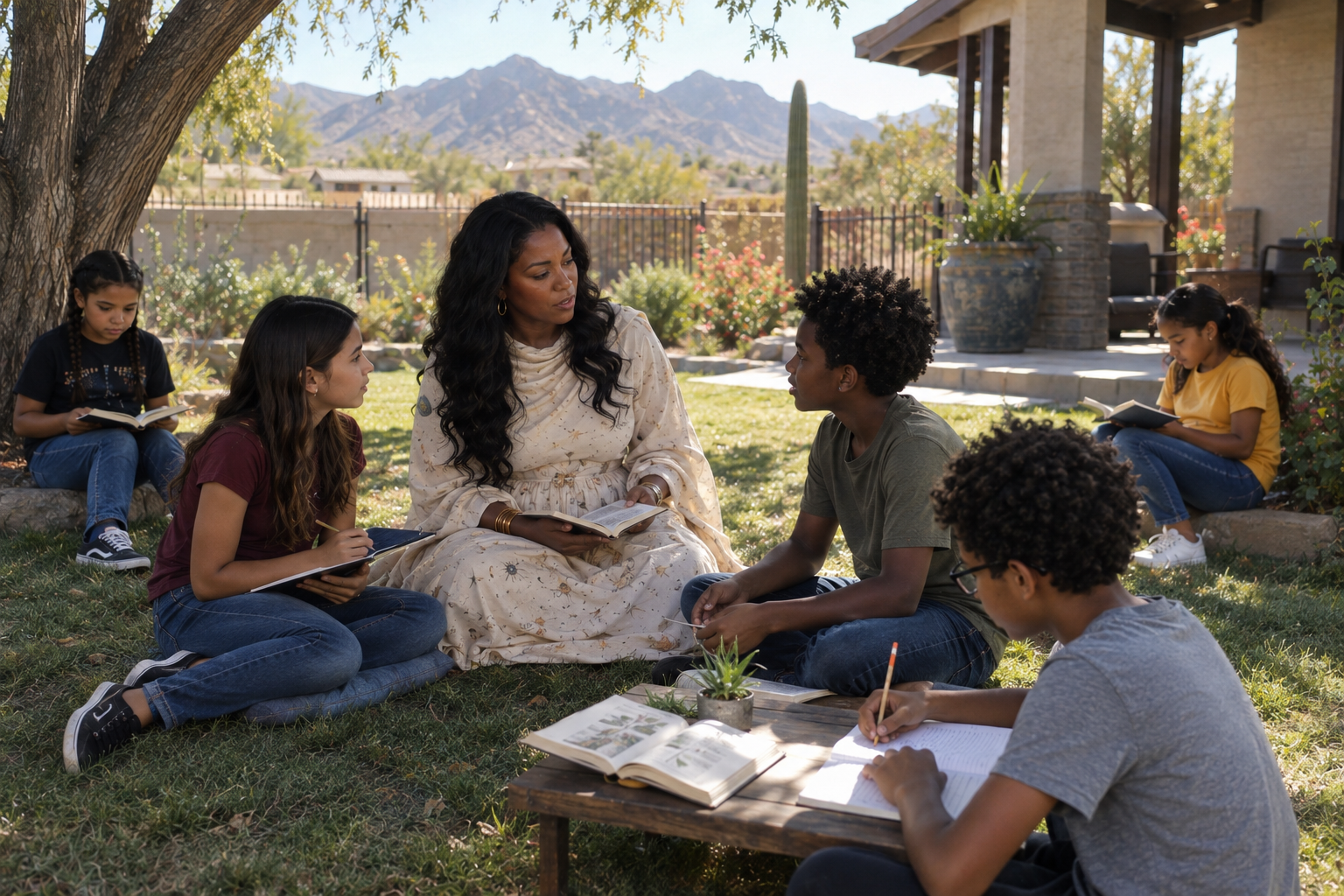
Homeschool families have an enormous advantage when it comes to developing reading comprehension: conversation can happen naturally throughout the day.
You don’t have to turn every book into a formal lesson.
Talk about it.
Ask your child what surprised them. Ask why they think a character made a particular choice. Ask whether they agree with something the author said. Ask what they think will happen next and, more importantly, why they think that.
If they give an opinion, occasionally ask, “What in the book makes you think that?”
That one question begins teaching children to support their thinking with evidence.
The conversation can become more sophisticated as children grow. An older student can compare characters, examine an author’s point of view, identify conflicting information, discuss bias, evaluate an argument, compare two sources, or explain how new information changed their thinking.
This is what I want reading to become.
Not a child searching a page for the sentence that matches a worksheet question, but a child actively thinking about what they are reading.
Writing Helps Us See What a Child Understands
Reading and writing belong together.
When I ask a child to write about something they have read, I am able to see parts of their thinking that may not be obvious during oral reading.
Can the student summarize without retelling every detail? Can they identify the main idea? Can they organize information logically? Can they explain cause and effect? Can they support an answer with evidence? Can they compare two ideas? Can they explain why they reached a particular conclusion?
Writing makes comprehension visible.
The expectations should, of course, be appropriate for the child. A younger elementary student may draw a picture and write several sentences about what happened in a story. An older elementary student might summarize a chapter, compare characters, explain a theme, or respond to a question using information from the text. A middle school student should gradually move toward more complex written responses that require analysis, evidence, organization, and explanation.
The purpose is not to make children write an essay about every book they read.
Sometimes reading should simply be reading.
But regular opportunities to write about reading help children learn to organize and communicate their thinking.
Yes, Handwriting Still Matters in an Online Learning Environment
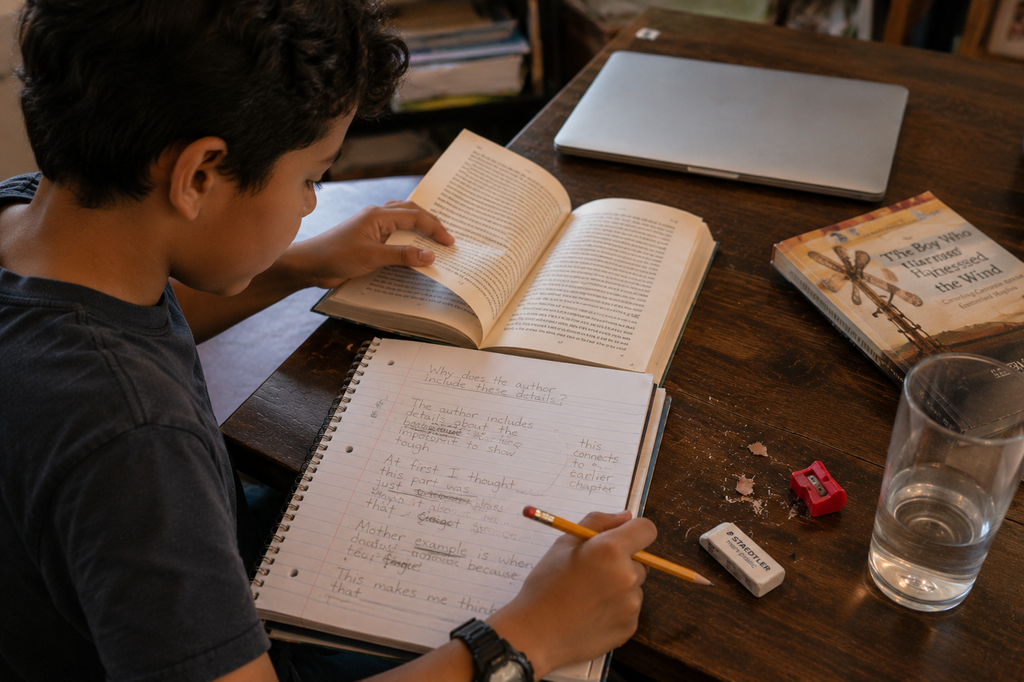
Even when students learn online, I still want pencils, notebooks, journals, books, and handwritten work to be part of their education.
Technology is useful. Students should absolutely learn how to type, research responsibly, use digital tools, and communicate in online environments.
But a computer should not become the entire learning environment.
Children can take handwritten notes while reading. They can keep vocabulary journals. They can sketch diagrams, jot down questions, organize ideas before writing, annotate information, and record observations.
In our classes, being online does not mean that learning only happens on the screen.
A student may receive instruction online and then close the computer to read, write, build, calculate, investigate, experiment, or work independently.
Reading comprehension develops through all of those experiences because comprehension is ultimately about making meaning.
Sometimes a Child Needs a Different Kind of Support, Not an Easier Book
When a child struggles to understand what they read, our first instinct may be to lower the reading level.
Sometimes that is appropriate.
But sometimes the child doesn’t need an easier book. They need better support for accessing the book in front of them.
Perhaps we need to introduce important vocabulary before reading. Maybe the child needs some background knowledge about the topic. A long chapter might need to be divided into smaller sections so we can stop and discuss what happened along the way.
Some students benefit from hearing part of a text read aloud while they follow along. Others need visual supports, a timeline, a character chart, a map, or a simple place to record important information.
An older child may need to be explicitly taught how to annotate or take useful notes rather than being told, “Take notes,” and expected to know what that means.
These supports do not remove thinking from the work.
They make the thinking more accessible.
The goal is not to make everything easy. The goal is to provide enough support that the child can engage successfully with appropriately challenging work and gradually need less help.
Strong Readers Know When They Need to Reread
I also want children to understand that rereading is normal.
Adults do it all the time.
We reach the bottom of a page and realize our mind wandered. We reread a complicated paragraph because we didn’t understand it the first time. We return to an earlier chapter because we’ve forgotten an important detail.
Strong readers do not understand everything instantly.
They notice when they don’t understand.
That is an important part of reading comprehension.
A child who finishes a page without understanding anything and simply continues to the next page needs a different skill from a child who stops and thinks, Wait. That didn’t make sense.
We can teach children to recognize that moment.
Sometimes I may say, “Let’s read that part again, but this time I want you to look for what caused the problem.”
Now the rereading has a purpose.
We aren’t sending the child backward as a punishment.
We are teaching them a strategy that competent readers use throughout their lives.
Don’t Do All of the Thinking for Your Child
This can be especially challenging when you are homeschooling your own child.
You know what the passage means. You know the answer. Your child is struggling, dinner needs to be made, someone else needs help with math, and it would take about ten seconds to explain everything.
But if we always supply the thinking, children can become very good at waiting for us to think for them.
Instead, I try to give enough help to get the thinking moving again.
“Show me the part that confused you.”
“What happened right before that?”
“What word don’t you understand?”
“Where could we find that information?”
“What makes you think that?”
“Is there another possibility?”
Sometimes the child will still need direct instruction. Of course they will. Teaching does not mean withholding help.
The difference is that I don’t want to automatically remove every opportunity for the child to reason independently.
Our goal is gradual independence.
Reading Comprehension Affects Much More Than Reading Class
One reason I care so much about reading comprehension is that problems in this area eventually begin appearing throughout a child’s education.
A student needs comprehension to understand a science article, interpret historical information, follow directions, research a topic, understand a health lesson, and make sense of a math word problem.
As students move into upper elementary and middle school, the amount of independent reading increases significantly.
A child who once appeared to be doing well may suddenly seem to be struggling in several subjects.
The science material feels difficult.
Social studies takes forever.
Written assignments become frustrating.
Math word problems are confusing.
Research projects feel overwhelming.
It can look like several unrelated academic problems when the common thread may actually be difficulty understanding, organizing, remembering, and communicating information from text.
That is why strong literacy instruction cannot stop once a child becomes a fluent reader.

A Reading Level Does Not Tell Us Everything About a Reader
Reading levels and assessment data can be useful. I use information from assessments too.
But I don’t want a number to become the child.
Two children can receive similar reading scores and need completely different things from us.
One child may have excellent comprehension but need continued support with decoding. Another may read fluently while struggling with vocabulary and inference. Another may understand literature beautifully but become lost in informational text. Another may explain everything verbally and then struggle to organize those same ideas in writing.
This is why I want to see children work.
I want to hear them read. I want to ask questions. I want to see what happens when the text becomes challenging. I want to know whether they recognize when something doesn’t make sense. I want to see how they respond to unfamiliar vocabulary and whether they can connect new information to something they already know.
I want to see the learner, not simply the score.
What Homeschool Parents Can Do to Strengthen Reading Comprehension
If you are concerned about your child’s reading comprehension, you do not need to turn your home into a reading intervention center or quiz your child after every chapter.
Start with reading and conversation.
Read good books. Read interesting nonfiction. Read together sometimes, even when your child is old enough to read independently. Let your child see you reading too.
Talk about unfamiliar words. Ask children to explain ideas in their own words. Encourage them to make predictions and tell you what evidence led them there. Connect books to places you visit, things you cook, experiments you conduct, historical events you study, maps you explore, art you create, and conversations happening in your family.
Let children write about some of what they read, but don’t require a written response to everything.
Most importantly, observe.
Notice where understanding begins to disappear.
Does your child struggle with long passages? Vocabulary? Remembering details? Identifying the main idea? Making inferences? Explaining ideas? Informational text? Written responses?
Those observations can tell us much more than simply saying, “My child struggles with reading.”
They begin helping us understand what kind of support the child actually needs.
We Are Trying to Develop Readers, Not Children Who Complete Reading Assignments
Ultimately, my goal is not to produce children who are exceptionally good at answering comprehension questions on worksheets.
I want something much bigger for them.
I want children who become absorbed in stories. I want them to encounter an unfamiliar idea and become curious enough to learn more. I want them to question what they read instead of assuming that everything in print must be true. I want them to recognize when something doesn’t make sense and know what to do about it.
I want them to develop the vocabulary to communicate increasingly complex ideas. I want them to explain their thinking, support their opinions, change their minds when new information warrants it, and understand perspectives beyond their own experiences.
I want them to read because books can be useful, fascinating, funny, comforting, challenging, strange, beautiful, informative, and sometimes completely transformative.
That is why reading comprehension matters so much.
When a child can pronounce every word on the page but cannot explain what those words mean together, I don’t see a child who has failed at reading.
I see information.
Something between the words and their meaning has not connected yet.
Our job is to observe carefully enough to find that missing connection and then teach from there.
Because learning to read the words is an important accomplishment.
Learning to understand, question, connect, and think about those words is what turns a child into a reader.
At Quantum Montessori®, literacy extends beyond completing reading assignments. Through meaningful literature, vocabulary development, handwriting, writing, discussion, observation, and individualized learning, we help students strengthen reading comprehension while developing the independence and critical-thinking skills they will use far beyond the classroom.
Leave a Reply