
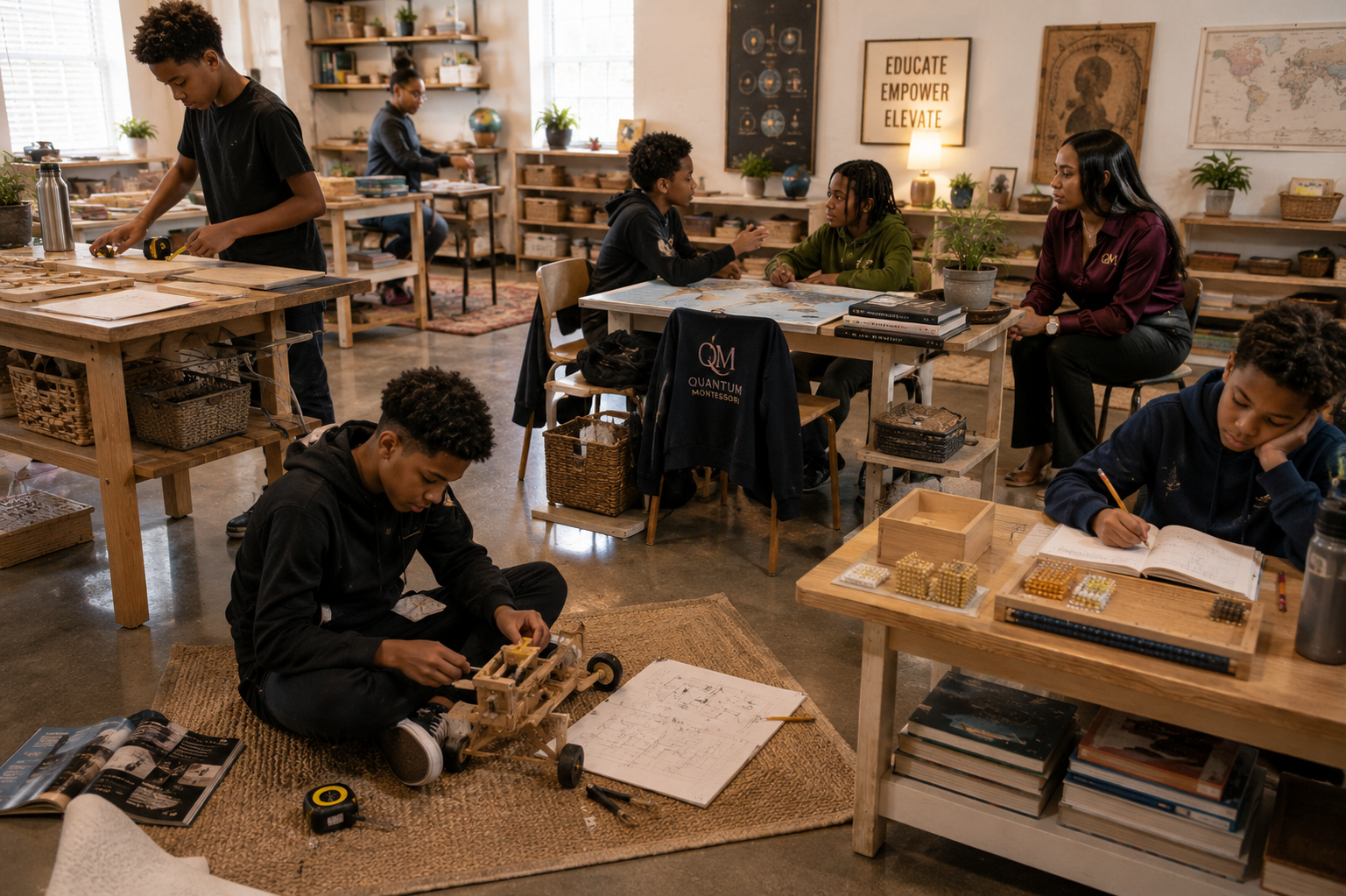
A Montessori Guide’s perspective on movement, challenge, dignity, culture, and meaningful work
There are two mistakes adults can make when we talk about improving education for Black boys. One is expecting children to succeed in environments that do not take their actual needs seriously. The other is responding to those concerns by quietly lowering the intellectual bar.
I do not want either one.
When I think about Montessori for Black boys, I am not interested in an educational philosophy built around the assumption that Black boys all learn alike. They do not. One child may love to build and move. Another may happily disappear into a novel for an hour. One may talk through every idea. Another may need time before he says anything. A student can be extraordinarily strong in mathematics and need significant support in writing. Another can write beautifully and become frustrated by multi-step calculations.
Black boys are children, not a learning style.
What I do believe is that every child benefits when adults look closely enough to distinguish ability from behavior, challenge from defiance, movement from disruption, a skill gap from lack of intelligence, and genuine independence from simply being left alone. I want our boys to receive meaningful academic expectations and enough appropriate support, time, movement, responsibility, cultural context, and hands-on experience to meet them.
Movement Is Not the Opposite of Learning
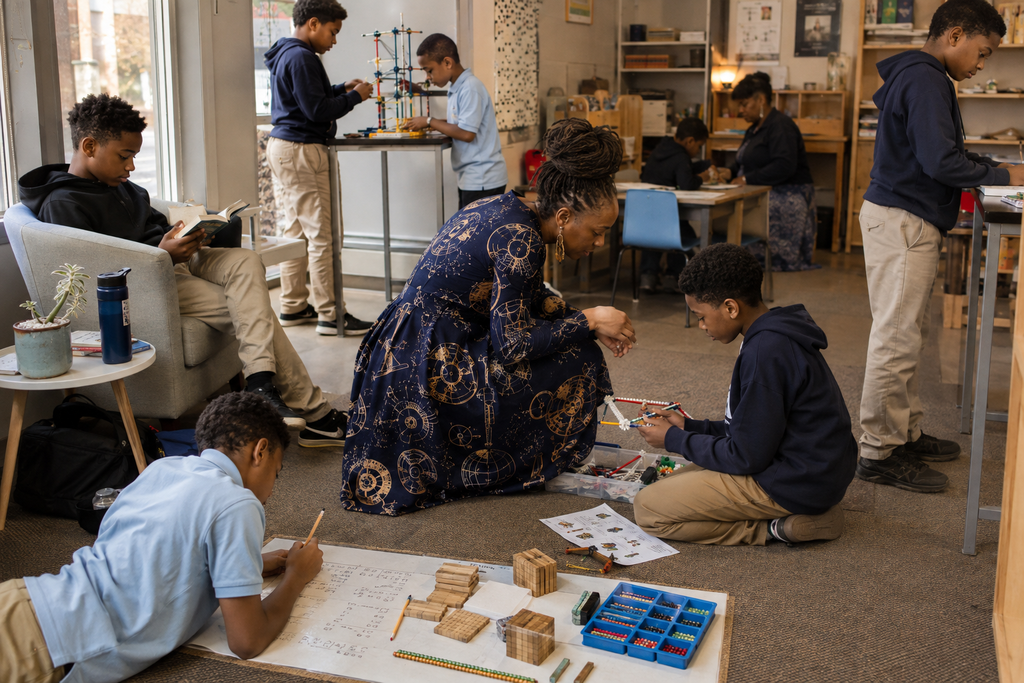
Some children think better when their bodies are allowed to participate in the day. That does not mean every Black boy is a kinesthetic learner, and I would not build an educational approach on that stereotype. It means I do not automatically interpret appropriate movement as evidence that learning has stopped.
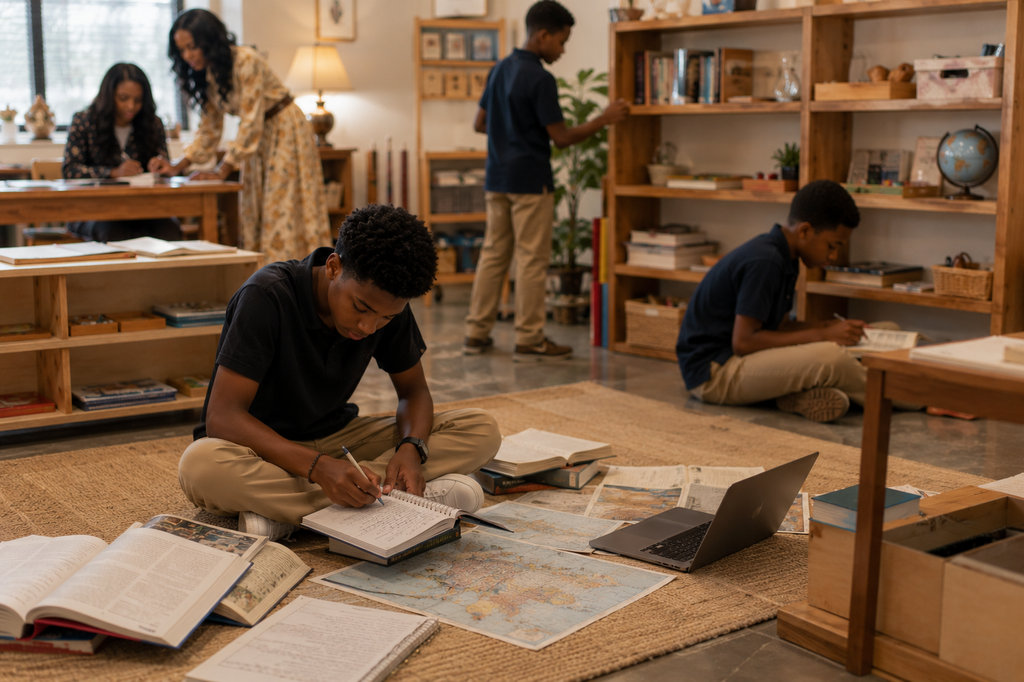
A student may stand while writing. Another may choose the floor for mathematics. A child might need to walk to a shelf, retrieve a material, work with it, restore it, and move to another part of the room. Science may take us outside. Practical life may take us into a kitchen. A history project may require students to spread a timeline across the floor because a desk is simply the wrong surface for the work.
Movement still has boundaries. Children cannot move in ways that prevent other people from working, make materials unsafe, or turn the environment into chaos. Montessori freedom exists within limits.
The important distinction is that I do not need a child to prove he is learning by remaining in one chair.
Difficulty Is Not Evidence of Low Ability
A child can be intelligent and still have a significant academic gap. Those ideas are not contradictory.
This matters because once adults begin interpreting difficulty as lack of ability, expectations can shrink very quickly. The reading becomes easier. The writing becomes shorter. The questions become less demanding. The child may complete more work, but he is not necessarily receiving more education.
I would rather identify what is actually interfering.
If a student understands sophisticated ideas but struggles to decode text, we need to address reading while continuing to give him access to meaningful ideas. If handwriting makes writing painfully slow, we can teach handwriting, develop typing, use oral discussion strategically, and continue building composition. If multiplication facts are weak, we can strengthen fluency without pretending the child is incapable of understanding more advanced mathematical relationships.
Support should help a student reach meaningful work. It should not quietly replace meaningful work.
He Needs to Know Why the Work Matters
There are assignments children must learn to complete simply because education includes responsibilities that will not always be personally fascinating. I do not think every lesson needs to be entertaining.
But purpose matters.
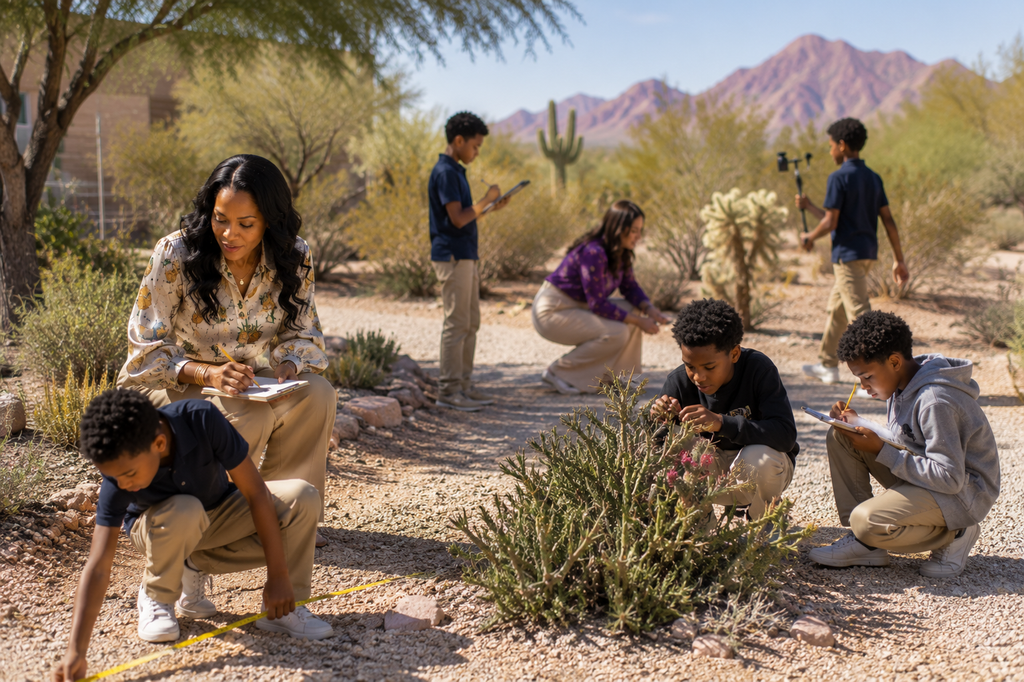
A student who sees mathematics appear in a construction project, cooking, scale model, budget, or science investigation begins to understand that numbers do something. A child researching a dinosaur because he is trying to explain a fossil to younger students has a reason to read carefully. A student writing an argument for a real audience has a different relationship to revision than a child writing five sentences that will disappear into a grading system.
Montessori education has always taken meaningful work seriously. Older children need work that becomes increasingly connected to the real world, intellectual questions, community, and responsibility.
When possible, I want the answer to “Why are we doing this?” to be better than “because it is on the worksheet.”
Culture Should Be Part of the Education, Not a Decoration Around It
I want Black children to know Black American history and culture as serious areas of study. That means moving far beyond a handful of famous names and a February bulletin board.
Students can examine primary sources, migration, inventions, music, literature, entrepreneurship, family history, political movements, military history, local communities, science, art, foodways, language, and the ordinary lives people built across generations. Older students should also learn to examine conflicting accounts, distinguish evidence from interpretation, and understand that history is complicated.
Representation matters here too. Children benefit from encountering Black men and women as scholars, scientists, writers, craftspeople, inventors, teachers, fathers, artists, attorneys, engineers, entrepreneurs, neighbors, and historical actors with full lives.
But culturally responsive education should not confine a Black boy to Black subjects. He should be free to become fascinated by ancient Rome, Japanese engineering, marine biology, astronomy, Shakespeare, coding, architecture, or anything else serious study opens to him.
Roots and range belong together.
A Question Is Not Automatically Defiance
Children should learn how to receive directions, respect boundaries, and communicate appropriately with adults. I am not interested in replacing expectations with the idea that every behavior is acceptable.
I am interested in knowing what happened before I decide what a behavior means.
A student who asks, “Why do I have to do it this way?” may be avoiding work. He may also have noticed another valid method. A child who becomes frustrated during a writing task may need a boundary around behavior and instruction in the skill causing the frustration. A student who talks constantly during a lesson may need to develop self-control, but he may also be showing me that discussion is one of the ways he processes ideas.
Observation keeps us from responding automatically.
Montessori asks adults to study children carefully. That does not mean excusing everything we observe. It means trying to respond to the actual child and the actual situation rather than to a story we formed before we looked closely.
Discipline Should Teach Something
I expect children to respect people, materials, time, and the learning environment. When a boundary is crossed, there should be a response.
The question is whether the response helps the child become more capable.
If a student damages a shared work area, restoring the environment may be part of the consequence. If he wastes the time allotted for a responsibility, he may need to complete that responsibility before moving to something preferred. If a group project breaks down because one person refuses to participate appropriately, the group may need to stop, examine what happened, redistribute responsibilities, and try again.
Consequences do not have to humiliate children in order to be meaningful.
I want discipline to move a child toward greater self-discipline, not simply greater skill at avoiding adults.
He Needs Opportunities to Become Competent
Confidence is often discussed as though adults can install it in children through enough encouraging words. Encouragement matters, but competence is one of the strongest foundations for confidence I know.
There is a particular expression a child has when he solves something that genuinely challenged him and knows that he solved it. Not because an adult praised him into feeling successful, but because he can see what he is now able to do.
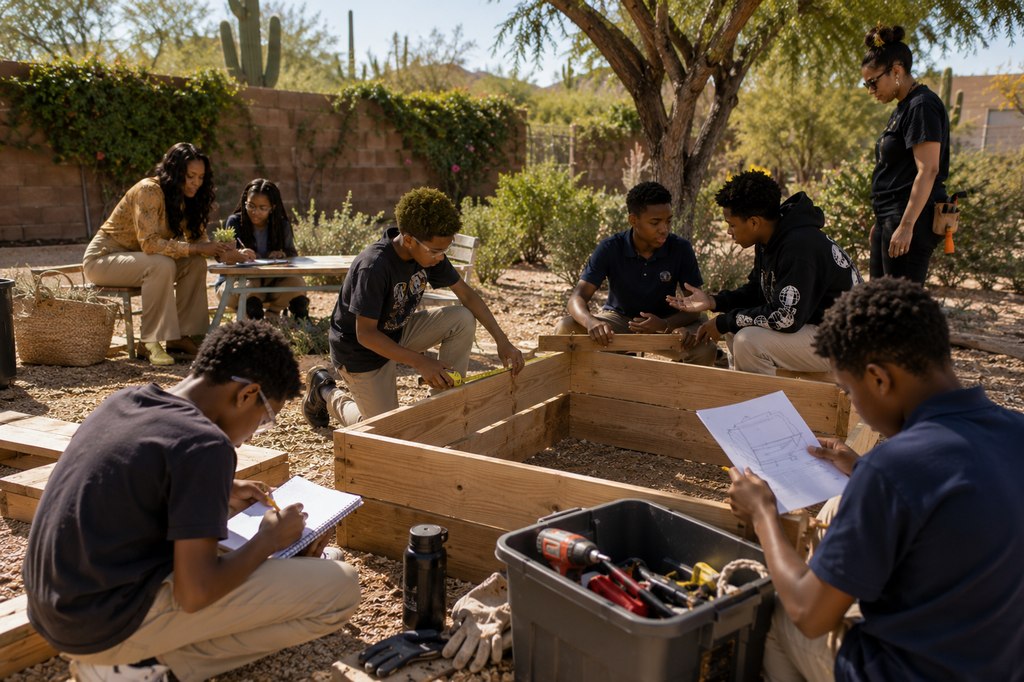
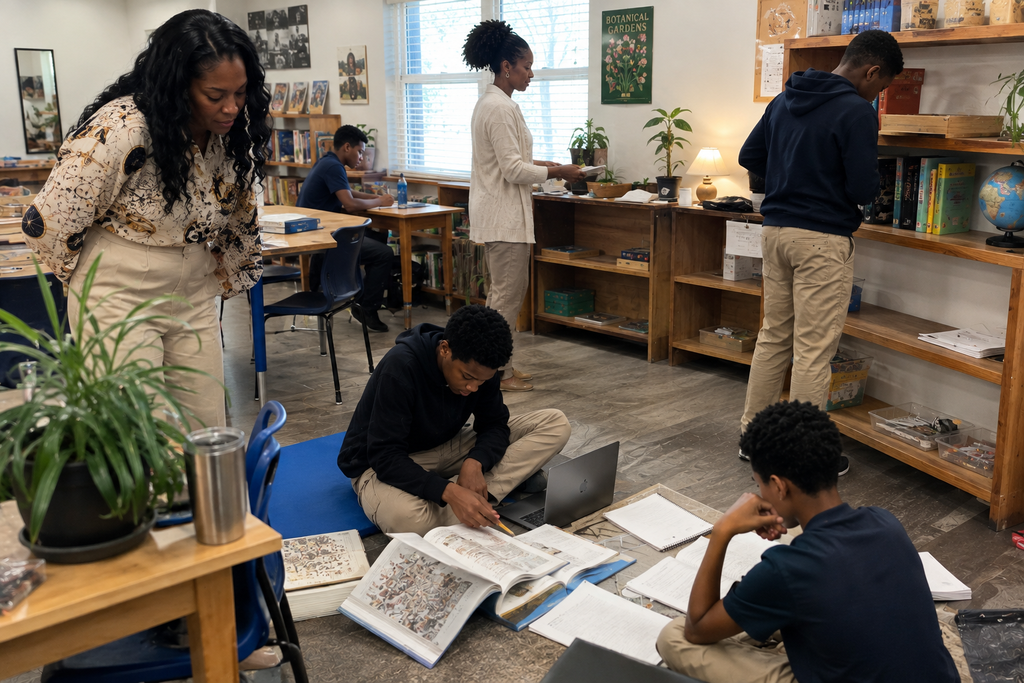
That experience can happen in mathematics, reading, cooking, gardening, research, repairing something, presenting a project, learning to type, writing an essay, conducting an experiment, caring for an animal, or teaching a younger child a skill he has mastered.
Children need enough support to reach those moments and enough freedom that the accomplishment still belongs to them.
That balance is central to Montessori for Black boys as I understand it. I do not want to constantly rescue a child and then tell him he is capable. I want to help him develop capabilities he can recognize for himself.
Closing
When I think about what Black boys need from education, I do not begin with the assumption that they are a problem a school must learn to manage. I also do not begin with the assumption that one educational strategy will work because a child is Black and male.
I begin with observation.
Who is this boy? What can he already do? What is difficult? What does he do when something is difficult? What subjects pull him in? Where are the gaps? Where is he ready to move faster? Does he need movement, quiet, conversation, repetition, a concrete material, a harder problem, clearer boundaries, more responsibility, or simply more time?
Then we teach the child we actually have.
I want Black boys to experience education as a place where intelligence is expected of them, not merely announced to them. They should encounter difficult books, substantial mathematics, research, science, art, history, practical responsibility, culture, debate, movement, and opportunities to make things that work in the real world. They should also be allowed to make mistakes without those mistakes becoming an identity.
At Quantum Montessori, Montessori for Black boys means combining dignity with expectations. It means observing the individual learner, providing appropriate support without shrinking the curriculum, creating room for purposeful movement and hands-on work, teaching cultural history with depth, establishing clear boundaries, and giving students increasing responsibility as their competence grows.
We are not trying to make every boy fit the same mold.
We are trying to build an environment substantial enough for each one to show us what he can become.
Leave a Reply