Hybrid Homeschooling: How Online Learning and Independent Work Can Work Together
From a Montessori Guide to Homeschool Parents
There is a version of hybrid homeschooling that sounds wonderful on paper. A child attends a few live classes, completes some work independently, and the family gets all the flexibility of homeschooling without having to carry the entire academic load alone. Then families actually try to live it, and the questions become much more practical. When should my child be online? What are they supposed to do when class ends? How much should I be helping? Does independent work mean they are teaching themselves? How do we fit lessons around appointments, activities, siblings, errands, and everything else happening in an actual home? And perhaps most importantly, how do we keep hybrid homeschooling from becoming conventional school delivered through a laptop?
Those are better questions than simply asking how many hours a child should spend online. When we work with families at Quantum Montessori, the goal is not to reproduce a school building inside someone’s home or keep children connected to a screen for most of the day. The live lesson is one part of the child’s education. There is also reading, writing, mathematics worked out by hand, experiments, research, conversation, movement, Practical Life, projects, independent work, and the ordinary experiences of being at home. A good hybrid model connects those pieces so that the technology supports the education without becoming the education.

Hybrid Homeschooling Is More Than Live Class Plus Homework
At its simplest, hybrid homeschooling combines guided instruction with learning that happens independently. Some of that instruction may happen live online with a Guide and other students, while other work happens away from the live class. I prefer to think about the distinction as more than synchronous versus asynchronous learning, however, because “asynchronous” can easily become shorthand for sitting alone at a computer completing digital assignments. That is not what I want for children. Independent learning might mean reading a physical novel, writing a response by hand, completing mathematics on paper, conducting an experiment, researching a question, preparing a meal, working on a long-term project, going outside to collect observations, or continuing work that began during a live lesson.
The live class gives us something important. It gives students access to direct instruction, discussion, questions, feedback, community, and a Guide who can observe what is happening and determine what may need to happen next. But I do not expect every meaningful part of a child’s education to occur while I am watching. One of the goals of Montessori education is to help children gradually develop the ability to work with increasing independence. Hybrid homeschooling can create a very natural environment for that development because the child moves regularly between guided instruction and responsibility for their own work.
The Work Should Continue After the Screen Closes
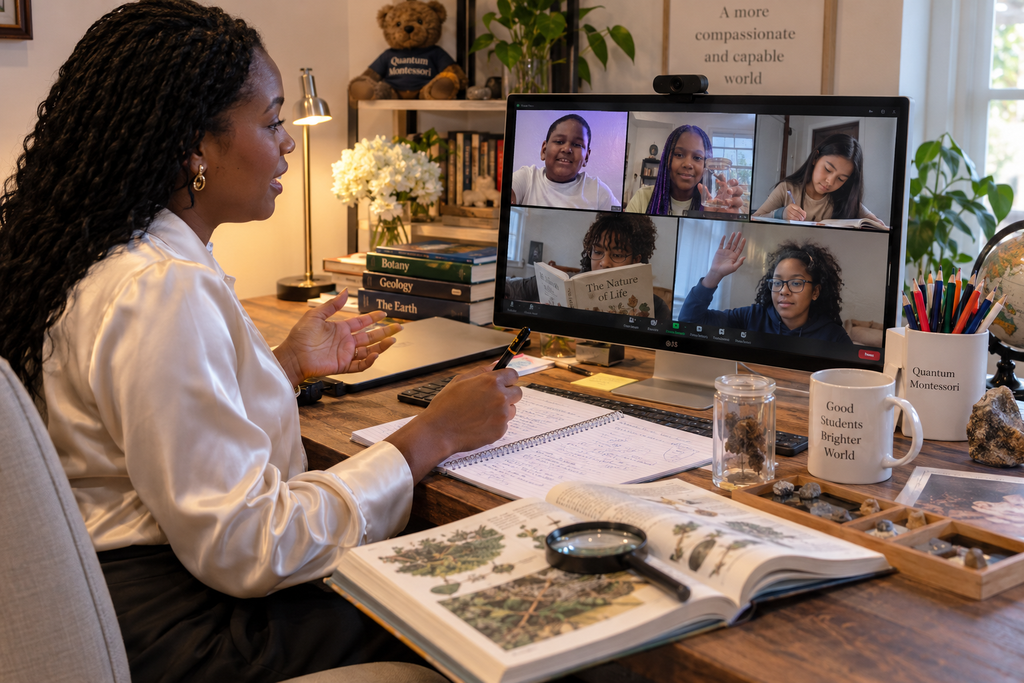
One of the easiest mistakes to make with online education is assuming that because technology connects the student to the teacher, technology should also contain the student’s work. It does not have to. I may introduce a mathematical concept during a live lesson, but the student may then close the computer and continue solving problems with pencil and paper. We may begin discussing a novel together, but the reading happens in a physical book later that afternoon. I can introduce a science question online and send students away from the screen to test, observe, measure, record, and come back with evidence. A student may receive instructions digitally and spend the next hour creating something that never requires another click.
That movement between instruction and application is important. Children need opportunities to do something with what they have learned before we assume they understand it. They also need to encounter the small problems that appear when an adult is not immediately directing every step. Where is the information I need? Which material should I use? What did the instructions say? Why didn’t this answer work? Should I reread the passage? Do I need to ask for help, or can I solve this myself? Those moments may look insignificant from the outside, but they are part of developing independence.
A Montessori Work Cycle Can Still Exist at Home
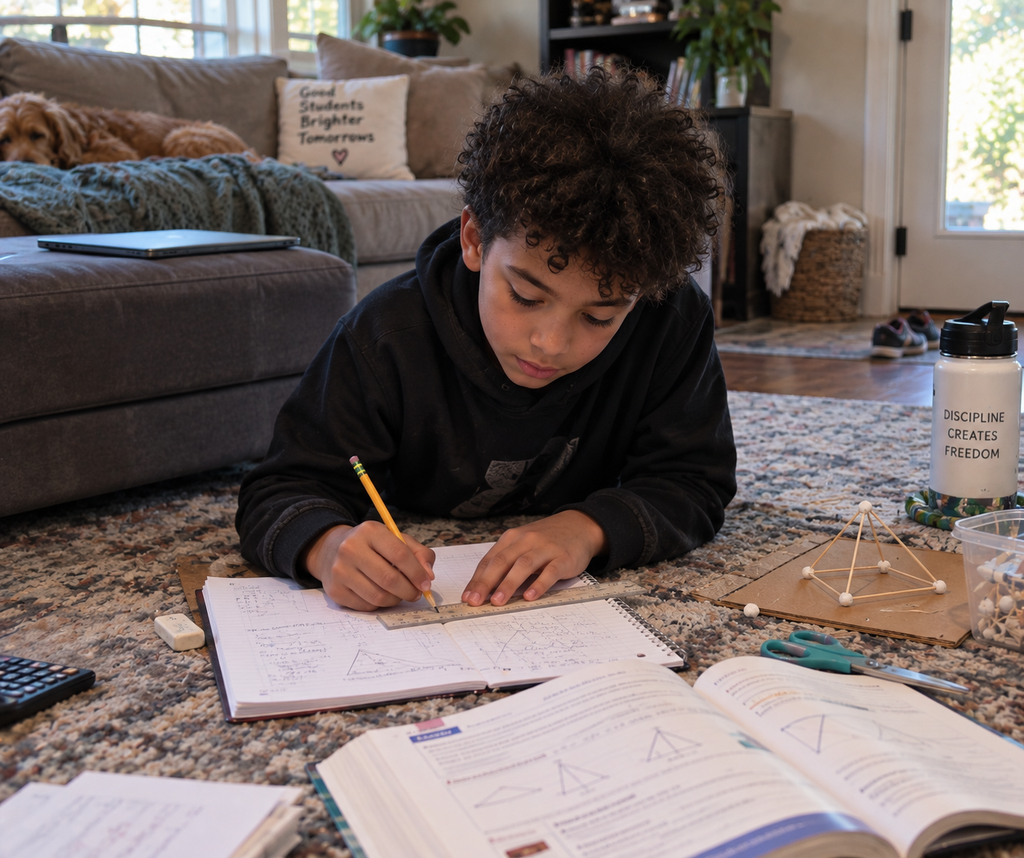
Structure matters in hybrid homeschooling, but structure does not have to mean recreating bells, rigid class periods, or a school desk in the corner of the living room. Montessori gives us another way to think about the day. A work cycle provides enough uninterrupted time for children to settle into meaningful work, make choices within established expectations, move between activities, solve problems, and complete work without an adult constantly announcing what happens every twenty minutes.
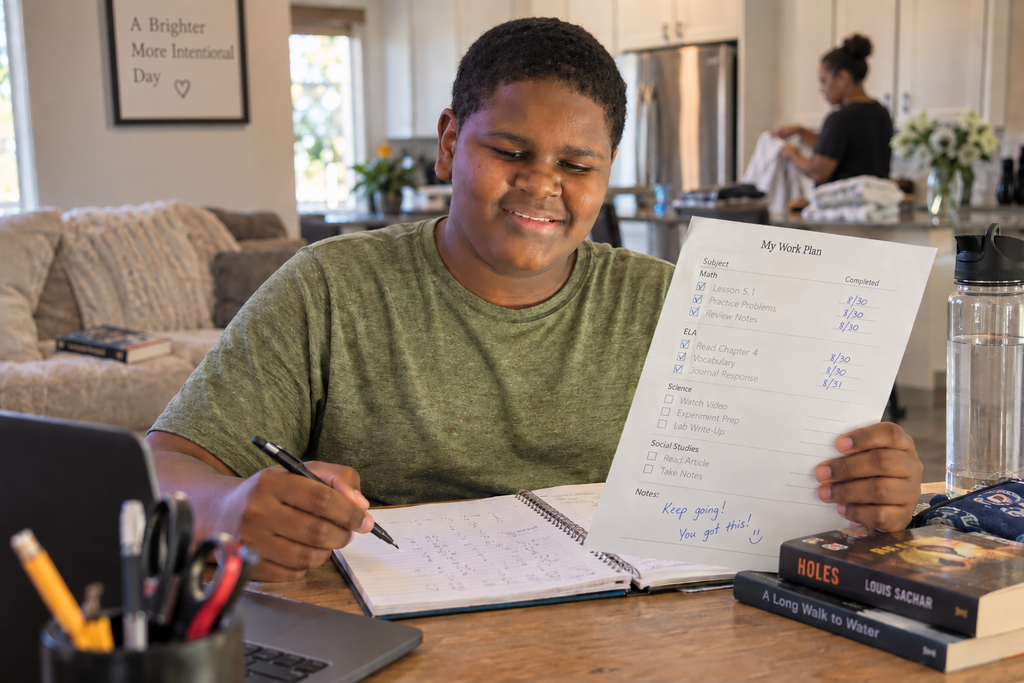
At home, that work cycle will look different from one family to another. Live classes provide anchors in the schedule, and independent work can be organized around them. A child may know which work must be completed that day while having some choice about sequence. Another student may need more structure and a clearly ordered work plan. A younger child may require more parent support during transitions, while an older student may be increasingly responsible for checking the plan, gathering materials, attending class, completing follow-up work, and determining when help is necessary. Flexibility does not require us to remove expectations. It allows us to build expectations around the actual child rather than forcing every child into an identical day.
Independence Does Not Mean Parents Disappear
Parents sometimes hear “independent learning” and understandably wonder what their role is supposed to be. Montessori independence has never meant leaving a child alone with work they do not understand and hoping they eventually figure it out. Independence develops through preparation. We teach. We model. We organize the environment. We establish expectations. We observe. We provide help when it is actually needed. Then, as competence develops, we gradually stop doing the parts the child can now do.
That distinction is especially important at home because it is incredibly easy to help too much. You see your child struggling to find something, so you find it. They hesitate over an instruction, so you explain it before they reread it. They make a mistake, and you point it out before they notice. They cannot remember what comes next, and you become the schedule. None of those moments seems significant individually, and sometimes stepping in is exactly what the child needs. But if we routinely do the remembering, organizing, noticing, interpreting, and problem solving, the child has fewer opportunities to develop those abilities.
A parent’s role in hybrid homeschooling is therefore not to become the child’s full-time classroom teacher while simultaneously supervising every assignment. Parents help create the conditions in which learning can happen. They communicate with the Guide. They help establish routines and maintain the learning environment. They make sure children have the necessary materials and support. They notice when something is consistently going wrong. For younger students, that involvement will naturally be greater. As students mature and demonstrate readiness, responsibility should increasingly move toward them.
Different Children May Need Different Versions of the Same Lesson
One of the reasons I value this model is that it gives us room to differentiate. Two children can attend the same lesson and need very different follow-up work. Grade level gives us useful information, but it does not tell me everything I need to know about a student. I also want to know what the child already understands, where there are gaps, how independently they work, what kind of challenge is appropriate, what interests them, and what I have observed while they are actually trying to learn.
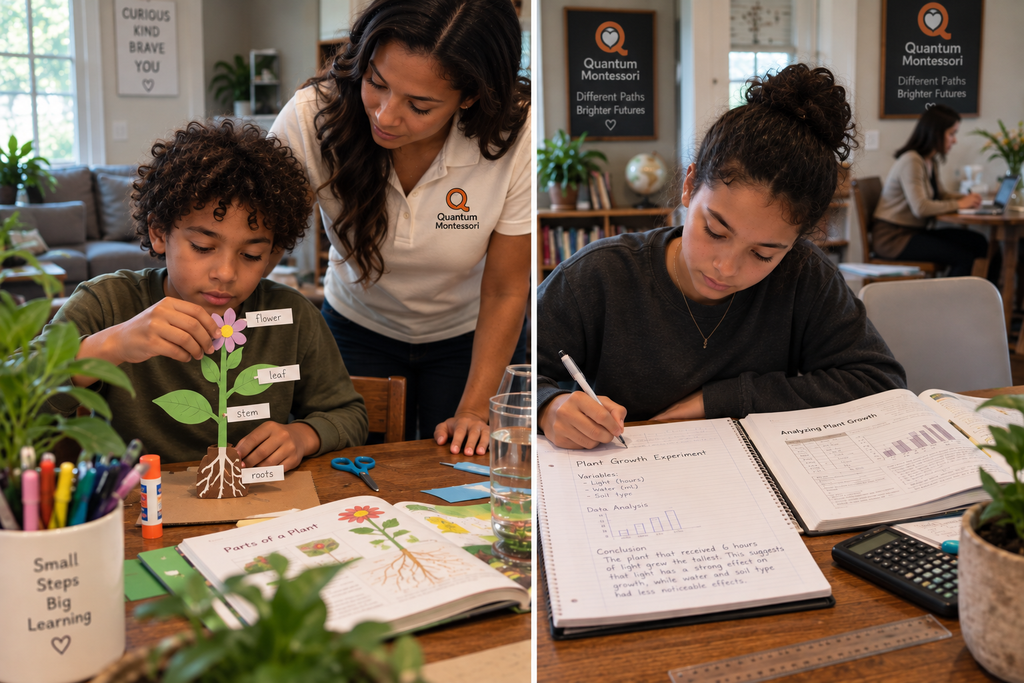
The same topic can therefore lead to different work. A younger student studying a science concept might create a labeled diagram and record a few careful observations. An older student may research the same phenomenon, compare data, write an explanation, or design an investigation. One student may need a concrete material before moving into abstraction. Another may be ready to apply the concept to a more complex problem. Individualization does not mean inventing an entirely different curriculum for every child every day. It means recognizing that equal access to learning does not always require identical work.
Home Is Part of the Learning Environment
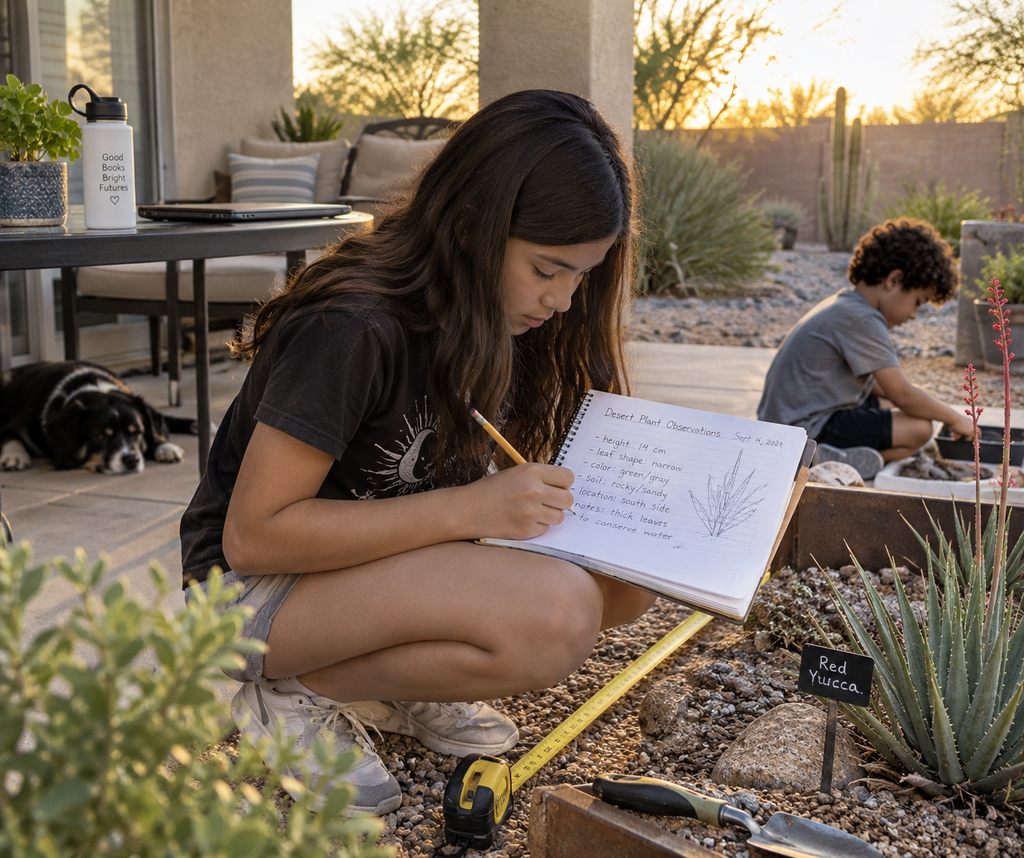
There is another advantage to hybrid homeschooling that I think is easy to underestimate: children are learning in a place where life is already happening. A kitchen contains mathematics, chemistry, sequencing, reading, responsibility, and Practical Life. A backyard can become a place for biology, weather observations, measurement, art, and writing. A trip to the grocery store involves budgeting, comparison, estimation, planning, and decision making. Libraries, museums, parks, community organizations, family projects, hobbies, and ordinary responsibilities can all become part of a child’s education without requiring us to label every experience as an assignment.
This does not mean children learn everything they need simply by living life. There is academic knowledge that deserves systematic, intentional instruction. There are skills that need practice even when they are not the child’s favorite thing to do. Montessori education is not an excuse to wait indefinitely for a child to become interested in every essential skill. But homeschooling gives us the freedom to connect formal instruction to a much larger world, and hybrid learning gives families access to educational support without requiring that the child’s entire education move outside the home.
Community Still Matters
Homeschooling should not require children to learn in isolation. Live classes give students opportunities to hear perspectives other than their own, ask questions, explain their thinking, disagree respectfully, work through ideas with peers, and become part of a learning community. Learning pods can provide another form of community through in-person work, projects, Practical Life, discussion, and collaboration. Independent homeschool students can also build community through field trips, extracurricular activities, libraries, clubs, sports, service organizations, neighborhood relationships, and the many other places children naturally encounter people.
The important thing is not to reproduce the social structure of a conventional school simply because it is familiar. Children need meaningful relationships and opportunities to participate in a community. They do not necessarily need thirty same-aged children in one room for seven hours a day in order to have them.
At Quantum Montessori, our broader goal is to support families across different learning environments rather than pretending there is one arrangement that works for every child. Some students benefit from regular live instruction. Some families want greater responsibility for directing homeschool at home while receiving planning and support. Some children thrive with opportunities to participate in a small learning pod. The educational environment can change while the Montessori principles underneath it remain recognizable: observation, meaningful work, independence, appropriate challenge, respect for development, and an environment prepared for the child who is actually in front of us.
The Goal Is Not to Create a Perfect Homeschool Day
A successful hybrid homeschool day does not need to look beautiful from beginning to end. Someone will occasionally forget a pencil. A child will take much longer than expected to complete something. Technology will misbehave. A lesson may reveal a gap that changes the rest of the week’s plan. A student may need more support than we expected, or surprise us by being ready to do something independently. A family appointment may rearrange the afternoon. Sometimes the experiment works. Sometimes it absolutely does not.
That is not evidence that homeschooling is failing. Education involves people, and people are not perfectly predictable.
What matters more is whether the structure is helping the child gradually become a stronger learner. Can they engage meaningfully during live instruction? Can they continue working when the teacher is no longer on the screen? Are they learning how to read instructions, manage materials, ask useful questions, persist through difficulty, communicate with others, and take increasing responsibility for their work? Are we observing enough to know when they need challenge and when they need support?
That is the potential I see in hybrid homeschooling. It can give families structure without requiring rigidity, professional instruction without making the computer the center of the child’s education, community without requiring every child to learn in the same physical space, and independence without expecting children to teach themselves.
The computer can connect us. The Guide can teach, observe, plan, and support. Parents can create an environment where learning has a place in family life. Children can read real books, write on real paper, conduct real experiments, solve real problems, participate in real conversations, and gradually take ownership of increasingly meaningful work.
When those pieces work together, hybrid homeschooling is not half of one kind of education and half of another.
It becomes an education designed to move naturally between instruction, independence, home, community, and the real world.