

A Montessori Guide’s perspective on movement, challenge, dignity, culture, and meaningful work
There is a version of the “good student” that adults often celebrate without examining very closely. She is mature. She is helpful. She gets her work done. She does not cause problems. She handles disappointment quietly. She may even anticipate what the adults around her need and adjust herself accordingly.
Those qualities can certainly reflect confidence and responsibility. But when I am teaching a Black girl, I also want to make sure I am not praising her for becoming exceptionally good at carrying things that should never have belonged to her in the first place.
She is still a child.
That matters to me when I think about Montessori for Black girls. I want our girls to receive a serious education. I want them to read deeply, write well, understand mathematics, investigate science, know history, develop practical competence, and learn how to defend an idea with evidence. I also want them to have room to laugh too loudly sometimes, change their minds, ask for help, make an imperfect first attempt, rest when rest is appropriate, become fascinated by something unexpected, and discover who they are without feeling as though they are constantly being evaluated as representatives of everyone who looks like them.
The goal is not to make Black girls smaller, quieter, tougher, softer, more agreeable, or more impressive. The goal is to give each girl enough room, structure, challenge, culture, care, and meaningful work to become more fully herself.

She Should Be Challenged Without Having to Be Perfect
High expectations matter. I do not think affirming children means making the work easy or protecting them from every uncomfortable academic moment. There will be books that require rereading, mathematics that does not make sense on the first attempt, writing that needs substantial revision, projects that take longer than expected, and moments when a student realizes that the answer she confidently gave is wrong.
That is learning.
What I do not want is for academic challenge to become entangled with a girl’s sense that she must perform perfectly in order to be seen as capable. A student should be able to struggle with fractions without deciding she is bad at mathematics. She should be able to receive feedback on an essay without hearing that feedback as a judgment about her intelligence. She should be able to say, “I don’t understand this yet,” without embarrassment.
In a Montessori environment, observation helps us find the difference between productive challenge and a child quietly drowning. Sometimes the student needs more time. Sometimes she needs a concrete material. Sometimes she needs the lesson presented differently. Sometimes she knows exactly what to do and needs us to stop rescuing her long enough to discover that she can do it.
The standard remains meaningful. The support becomes responsive.

She Needs Literature That Makes the World Larger
Representation matters to me, but I want to be careful about what I mean by it. I do not want Black children to encounter Black characters only during a designated month, only in stories about suffering, or only when a lesson has been labeled cultural. Black girls should encounter Black women and girls in history, science, literature, art, invention, family stories, ordinary fiction, humor, adventure, fantasy, and contemporary life.
At the same time, culturally meaningful education should not become a smaller intellectual world. A Black girl should be able to study Mae Jemison and the solar system, Zora Neale Hurston and Shakespeare, the history of Black American communities and ancient civilizations across the world. She can investigate the Great Migration one month and become completely obsessed with dinosaurs the next.
Culture should give a child roots. Education should also give her range.
This is one reason I prefer literature discussion to simply assigning comprehension questions. I want to hear what a student thinks about a character. I want her to disagree with me. I want her to notice something I missed. I want her to ask whether the narrator is reliable or whether a historical account leaves someone out. When children realize that reading gives them something worth discussing, books become more than assignments.
Her Voice Does Not Need to Sound Like Mine
Adults sometimes say that we want children to find their voices, but then become uncomfortable when the voice we hear is assertive, skeptical, funny, unconventional, or simply different from ours.
A learning environment should teach children how to communicate respectfully without teaching them that respect means agreement.
A girl can question an interpretation. She can defend a different solution. She can say that a book did not work for her and explain why. She can tell me that my directions were unclear. She can learn to disagree with a classmate without attacking the classmate. She can revise her position when someone else presents better evidence.
Those are academic skills and social skills at the same time.
For Black girls especially, I want to be thoughtful about the difference between teaching appropriate communication and policing personality. The goal is not to manufacture one acceptable way of being a girl. Some children are naturally quiet. Some are animated. Some lead quickly. Some watch for a long time before speaking. Montessori for Black girls should leave room for those differences while helping every student become capable of expressing ideas clearly and listening seriously to others.

Rest, Beauty, and Care Belong in Education Too
The original idea behind this article was that Black girls need more than academic instruction. I still believe that. The part I would say differently now is that care does not have to be turned into another program children are required to perform.
Sometimes care looks very ordinary.
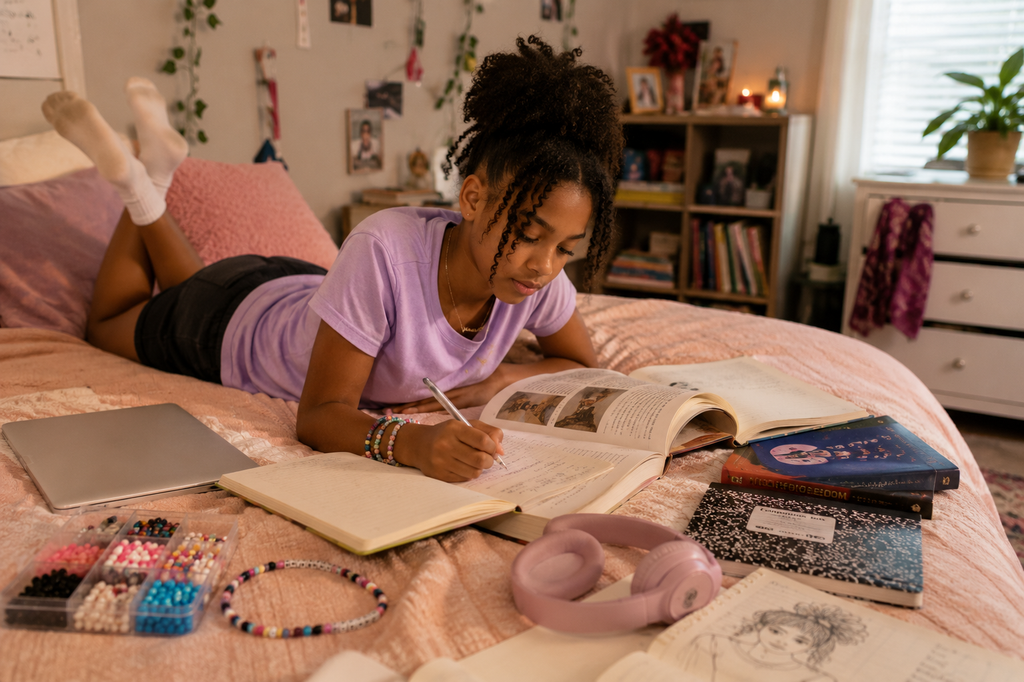
It is a room with natural light and a comfortable place to read. It is being able to get water without asking permission for every basic need. It is movement after sitting for a long period. It is knowing that a teacher will notice when something is genuinely wrong. It is having art supplies that invite real creation rather than busywork. It is learning how to prepare food, care for one’s environment, organize belongings, and understand the body’s need for nourishment and rest.
Beauty matters in Montessori environments because the surroundings communicate something about how we expect people to treat the space and one another. I want materials to be inviting and accessible. I want flowers, plants, art, books, natural textures, and objects with history and meaning. I also want the environment to be lived in. A beautiful room occupied by children will not remain photographically perfect all day.
That is fine.
The purpose of the environment is to support the people in it.
Leadership Should Include the Freedom Not to Lead
I want girls to have opportunities to lead, but I do not want leadership to become another expectation they are required to fulfill.
Sometimes leadership is presenting research to a group. Sometimes it is organizing part of a project, teaching a younger student how to use a material, or recognizing that the group is missing an important perspective. Sometimes a child needs to follow someone else’s lead and learn how to contribute without controlling the outcome.
There is value in both.
A healthy community allows children to try different roles. The student who always volunteers first may need practice listening. The child who stays in the background may need an opportunity to take responsibility for something she knows well. A student who is accustomed to doing everything herself may need to learn that asking for help is not failure.
I am less interested in telling every Black girl that she must be a leader than I am in making sure she develops the competence and confidence to lead when the moment calls for it, collaborate when that is appropriate, and know that her worth is not dependent on how much she carries for everyone else.

She Also Deserves to Be Silly
There is another part of whole-child education that can disappear when adults become very serious about preparing children for the world.
Children need joy.
Not manufactured classroom fun every minute. Not an adult turning every assignment into a game. I mean the spontaneous joy that appears when children are allowed to know one another, make something, cook together, become obsessed with an unusual subject, laugh over a mistake, run outside, invent a joke that makes absolutely no sense to us, or spend twenty minutes debating which dinosaur would be the worst possible house pet.
Those moments are not interruptions to childhood.
They are childhood.
Academic rigor and joy are not opposites. A girl can write a carefully researched paper in the morning and laugh until she can barely speak at lunch. She can conduct a serious science investigation and still name the classroom lizard something ridiculous. She can be brilliant without performing brilliance every minute of the day.
When I think about Montessori for Black girls, I do not begin with a list of things that are supposedly true about Black girls. I begin with the girl in front of me.
What does she know? What is she curious about? What is difficult for her? What does she do when something becomes challenging? Where is she confident? Where does she hesitate? What makes her laugh? What responsibilities is she ready to carry? Which ones have adults placed on her too soon? What kind of support allows her to do more for herself rather than making her dependent on us?
Those questions lead to a more human education.
I want Black girls to receive the intellectual seriousness they deserve without having their childhood traded for it. I want them to experience culture as something expansive and alive. I want them to develop independence without believing they must always handle everything alone. I want them to learn how to speak and how to listen, how to lead and how to follow, how to persist and how to recognize when they genuinely need help.
Most of all, I want each girl to have enough room to become someone we could not have completely planned in advance.

At Quantum Montessori, our work begins with observation of the individual child. We use Montessori principles, meaningful academic work, practical life, cultural study, conversation, movement, creativity, and individualized support to create an environment where children can grow in both competence and self-knowledge. For us, Montessori for Black girls is not about creating a special mold for Black girls. It is about making sure they are fully seen, appropriately challenged, culturally respected, and given room to bloom.
Leave a Reply